
UK coup d’état plots in 19-20th centuries
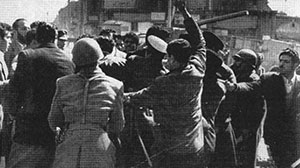
Britain’s spying agencies have plotted several coups around the world, including Iran’s coup d’état of 1921, through which former dictator Reza Pahlavi came to power, and the 1953 coup which resulted in the toppling of the democratically elected government of Iran under Mohammad Mosaddegh.
After World War I, Britain decided to plot a coup to bring an end to the Bolsheviks’ penetration of Iran for the threat it imposed on British possessions in India.
Therefore in February 1921, British officials who were dismayed by the Qajar Dynasty in Iran, put Reza Pahlavi on the throne by providing his troops with ammunition, supplies and pay to help them seize control of the capital city of Tehran in the coup they plotted themselves.
Moreover, in 1953 Britain’s secret intelligence agency MI6 and the United States’ Central Intelligence Agency (CIA) organized a coup to remove the then elected Prime Minister Mohammad Mossadegh. British officials then propped up the increasingly brutal regime of the Shah [Mohammad Reza Pahlavi] until its collapse in 1979.
Not surprisingly, in a documentary aired on August 18, 2011 on the anniversary of the 1953 coup d’état, Britain’s state-run broadcasting cooperation BBC admitted to the role of the BBC Persian radio as the propaganda arm of the British government in Iran.
The BBC program entitled Cinematograph detailed for the first time how the radio network broadcast anti-Mosaddegh programs to undermine his government.
“The British government used the BBC Persian radio for advancing its propaganda against Mosaddegh and anti-Mosaddegh material were repeatedly aired on the radio channel to the extent that Iranian staff at the BBC Persian radio went on strike to protest the move,” the Cinematograph narrator said.
But that is not all, as there is no end to Britain’s decades of subversive activities and imperialistic interests.
In 1939, the cooperation between Yugoslav Intelligence Service and British spying agencies was intensified after the occupation of Austria and annexation into Germany. But the two countries’ combined intelligence operations did not last too long as Britain’s policy towards the government of Yugoslavia had shifted from acceptance of its neutrality to pressuring the country for support in the war against Germany.
It was then in March 1941 when Britain planned and directed the Yugoslav coup d’état with British intelligence services supporting the coup plotters. The 1941 Yugoslav coup led to the overthrow of Prince Paul and brought to power the 17-year-old King Peter II.
There are also reports that Mark Thatcher, the son of former British Prime Minister Margaret Thatcher, pleaded guilty in relation to the 2004 Equatorial Guinea coup d’état attempt organized by his friend, Simon Mann.
The charges were related to “possible funding and logistical assistance” in relation to the attempted coup, aimed at toppling President Obiang. Thatcher was then fined 3,000,000 South African rand (£215000), and received a four-year suspended jail sentence.
Britain’s coup plots have not been just against other nations as in 1968, at the time of former PM Harold Wilson, a number of Britain’s secret internal security service (MI5) officers plotted a military coup in Britain.
According to reports, Lord Louis Mountbatten, Admiral of the Fleet and a cousin of the Queen, was asked to serve at the head of an alternative government once Wilson had been ousted.
British officials, however, seem not to be pleased when it comes to Egypt coup with Britain’s Foreign Secretary William Hague calling the recent overthrow of Egyptian President Mohamed Morsi a “dangerous thing”.
“We will always be clear that we don’t support military intervention,” Hague said.
However, he later tempered his condemnation of the army’s role in Egyptian politics, saying it was a “popular intervention.”
Egypt underwent several decades of British rule until independence in 1922, while Britain invaded Egypt along with France and “Israel” in the 1956 Suez crisis.
Source:Press TV
M.D