
“Zukhruf” project in Aleppo revives Ajami art
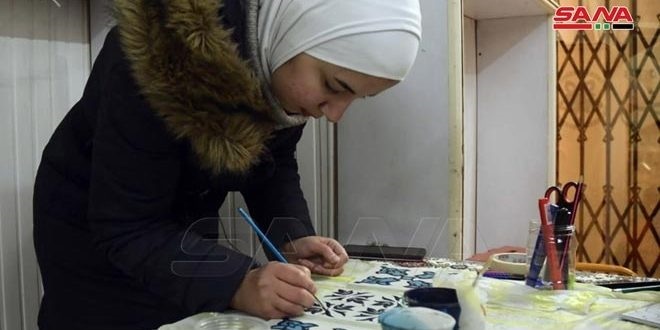
Ajami ( Damascene painting) handmade art as wood paneling has been popularly practiced in the sixteenth to late eighteenth century especially during the Omayyad and the Ottoman period.
Ajami is used to describe the technique of painted wooden wall panel as well as the interior as a whole. Nowadays, it can be seen that this beautiful decorative painting technique is subjected to threats and would gradually become one of an extinct art in Syria.
Ajami art embodies through its decorations the originality and nobility of the deep-rooted ancient heritage that adorned palaces and mosques with a distinctive oriental feature , in addition to being an ancient Syrian handmade craft .
With the aim of preserving and reviving Ajami art, the craftsmen of the city of Aleppo and a group of women were keen on playing an effective role in this connection and launched their project “Zukhruf ” in the Silk Market in the old city of Aleppo.
The Head of the mentioned project Nadera Rabi’e, said in a statement to SANA that “The project started in 2017, at the initiative of the “Subul” Development Team in cooperation with the Union of Charitable Societies” stressing Ajami art was chosen because it is one of the handicrafts that are threatened with extinction so a group of women were trained in the field of Ajami art skills in addition to ways of marketing.
She added that in 2019, the women participated in the restoration of old Ajami artworks and manufactured Ajami furniture through a workshop that met their desire to continue work and gain experience in this field, noting that professional traditional Ajami drawings are selected to meet the requirements of the modern era .
Bayan Haj Ali, a member of “ Zukhruf” project explained that she introduced modernity to Ajami art by merging it with Al-Qishani art to suit all tastes.
In turn , Mais Kourani, a student at the College of Fine and Applied Arts, expressed her passion for learning Ajami art, which is characterized by drawings with botanical and geometric shapes on the double-sided polished wooden board, where she works on printing the shapes.
Rawaa Ghanam