
Zionist Entity is Fighting a Regional War in Syria
The changing internal situation in Syria is putting a new set of plans into motion, which involve Israeli aggression against Syria.
Not only have the US and its allies been trying to militarily buttress the retreating anti-government militias, but now they aim to create a new phase in the conflict where states start asserting leverage against Syria in place of the weakening anti-government forces. In other words, external pressure is being applied to replace the declining internal pressure.
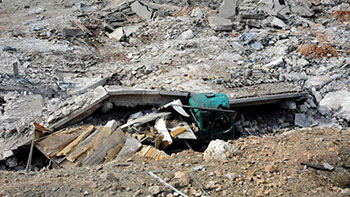
The entry of Israeli troops and the Mossad security service into Syria with repeated Israeli air strikes via illegal use of Lebanese airspace on the Syrian military research facility in the town of Jamraya clarifies Israel’s role in destabilizing Syria. Israel has also admitted that “intense intelligence activity” is being maintained in Syria by Israeli forces and that it is even thinking of occupying more Syrian territory as a new “buffer zone.” Fox News, which is openly biased in favour of Israel, has released a video of Israeli troops illegally crossing the Syrian border. Reports have also come out of Syria that an Israeli military vehicle was seized during fighting with anti-government forces in the town of Qusair, inside Syrian territory.
Epicentre of a Regional War?
The events involving Israel are part of the trend to expand and internationalize the crisis in Syria by creating violent spillovers. In the words of one British newspaper: “If anyone had doubts that Syria’s crisis is already spinning into a wider Middle East conflict, [Israeli attacks in] the past few days should have laid them to rest.” Turkey and Israel, like the Hashemite Kingdom of Jordan, are themselves undeniably involved in the fighting as aggressors against Syria. Turkey has conducted reconnaissance work for NATO in Syria, it hosts NATO Patriot missiles aimed at Syria (with the possibility of deployment against Iran and Russia), and openly aids the anti-government forces. Israel has been the more discreet of the two, but it has sent the Mossad into Syria and built facilities in the Golan Heights to aid the terrorists. Both countries have continuously threatened Syria and pushed for NATO intervention and no-fly zones. All the while, the US has been prodding Ankara and Tel Aviv to continue with the war footing and has even examined selling Turkey natural gas from the US to economically de-link the Turks from Syria’s allies Russia and Iran and the leverage they have over Turkey.
In reality, Syria is merely one front in a broader hegemonic struggle that spans from NATO-garrisoned Afghanistan and Iraq to Lebanon and the Gaza Strip. The Lebanese Republic looks like the next target for destabilization in the broader struggle that Syria is a front in. There are fears that there may be a parliamentary and governmental vacuum in Beirut as a result of the spillover from Syria that could be capitalized to ignite another Lebanese internal conflict. Tensions between the pro-Syrian Hezbollah-led March 8 Alliance and the anti-Syrian Hariri-led March 14 Alliance have been building as a result of the conflict in Syria. Both sides in Lebanon are involved in the Syrian conflict.
On the other hand, the conflict in Syria has been the catalyst for a strengthening Russian position in the Middle East and the forging of new ties between Hezbollah and Moscow. In October 2011, Hezbollah sent a delegation to Russia to discuss the fighting in Syria. It is clear now that Moscow is coordinating with the Iranian-led “Axis of Resistance” or Resistance Bloc that includes Syria, Hezbollah, Michel Aoun, and the Palestinians. After holding discussions about Syria in Tehran, Russian Deputy Foreign Minister Mikhail Bogdanov’s April 26 visit to Beirut, during the absence of a formal Lebanese government, embodies this strategic cooperation. Bogdanov’s trip to Lebanon is important, because it was a clear indicator that Russia has forged direct strategic ties with Hezbollah and recognizes the Resistance Bloc as an extension of its own security sphere.
Syria and the Project for the “New Middle East”
What happens in Syria will have major regional and global repercussions. Attempts to create a sectarian war are part of the logic of divide and conquer. This is part of the US and Israel “constructive chaos” strategy to fragment and re-sculpt the entire Middle East along the lines of the Yinon Plan and rehashed versions of it. Iran’s Foreign Minister Salehi has warned that if the conflict in Syria is not ended that it will result in the partition of Syria and the spreading of the conflict throughout the Middle East. The same warnings have been echoing from Russia, Syria, and other places. While the Chinese have kept mostly silent, they realize that the siege of Syria is part of the Pentagon’s roadmap against China. Days before Benjamin Netanyahu was scheduled to arrive in Beijing, CNN even reported that “China’s foreign ministry spokesman suggested Netanyahu may get a tough, unwelcome message from his Chinese hosts” due to the Israeli strikes on Jamraya.
There should be no doubt that the terrorists in Syria and Israel are on the same side. The anti-government forces in Syria have even thanked Israel on several occasions and were jubilant about the Israeli attacks on Jamraya
It says something of significance when Israeli officials say that they do not see an Al-Qaeda takeover of Syria as a threat to Tel Aviv. Amos Gilad, an Israeli military official, has stated very frankly Al-Qaeda is no concern for Israel and “although [its] elements are gaining a foothold in Syria amidst the chaos of the country’s civil war, the Syria-Iran-Hezbollah axis which preceded it [is] far more threatening” for Israel.
In reality, the governments of Israel, Turkey, Saudi Arabia, Qatar, the United Kingdom, France, and the United States are in league with the supposed terrorists that some of them say they oppose or are fighting. They have been using the groups that have been designated as branches of Al-Qaeda as foot soldiers on the ground in Syria and Libya. If successful, they will eventually try to use the same militants to ignite insurgencies in places like Russia’s North Caucasian Federal District.
Source:GlobalResearch
M.D