
With the participation of Syria… of the Baghdad International Water Conference is launched
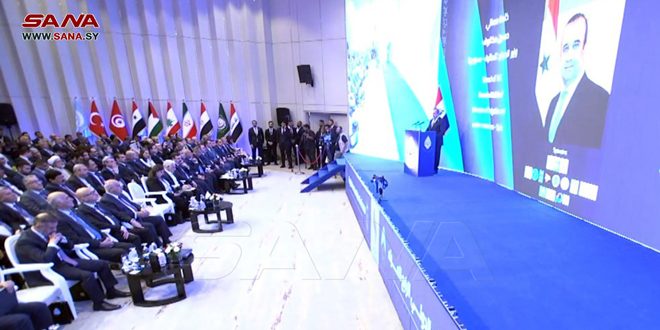
With the participation of Syria, the work of the 4th Baghdad International Water Conference was launched today in the Iraqi capital under the slogan “For a better water future… together we can” to discuss water challenges and international relations and to strengthen partnerships in this vital file.
The Syrian Minister of Water Resources Eng. Husssien Makhlouf said in his speech at the opening session of the Conference:” the cooperation in the field of water issues has become a necessity in the light of the interconnection between water-related issues and all the challenges we face”. He called on all countries to “work together to provide water in a sustainable way at the lowest possible costs meeting the needs of the current and future generations in line with steady population growth and comprehensive development”.
Makhlouf added: “Syria highly values cooperation in the field of water in line with international law to preserve water rights and achieve water security, and has always encouraged all forms of solidarity and joint action”.
Makhlouf pointed to “the negative effects of the unilateral coercive sanctions imposed on the Syrian people, which hindered the possibility of rebuilding the country’s water sector in light of a decade of terrorism in addition to the earthquake disaster that Syria witnessed last year and the Corona crisis”. He stressed the necessity of lifting the unjust and illegal siege imposed on the Syrian people.
Makhlouf stressed “commitment to international water agreements with neighboring countries and seeking to obtain fair and equitable shares of international river water on a permanent basis in order to avoid negative effects on agriculture, development, environment, and health as a result of the decrease in abundance”.
In turn, Iraqi Deputy Prime Minister Muhammad Tamim stressed that the upstream countries must guarantee the actual needs of the downstream countries in accordance with international law, calling for the rationalization of water consumption to face the serious challenges of climate change.
For his part, the Iraqi Minister of Water Resources, Aoun Dhiab, said: “The conference will serve as a gateway to communication with the regional and international environment to develop solutions to water crises coinciding with climate change”. He added: “Iraq is focusing on finding advanced solutions to the water crisis and enabling its equitable distribution to beneficiaries on the Tigris and Euphrates rivers”.
Dhiab called on Arab and international organizations to cooperate fruitfully and constructively to preserve the just water environment, noting that it is “a shared responsibility that belongs to everyone in all sectors”.
The conference aims to manage water as one of the most important foundations for strengthening international relations and the role it plays in developing relations between peoples and societies and achieving stability at the local, regional and international levels.
Souha Suleiman