
WHO urges shift to single-use smart syringes
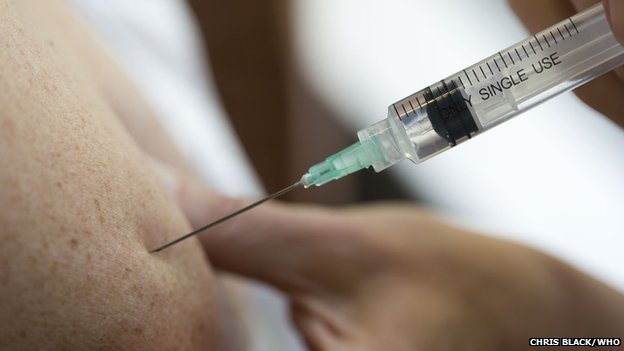
Smart syringes that break after one use should be used for injections by 2020, the World Health Organization has announced.
Reusing syringes leads to more than two million people being infected with diseases including HIV and hepatitis each year.
The new needles are more expensive, but the WHO says the switch would be cheaper than treating the diseases.
More than 16 billion injections are administered annually.
Normal syringes can be used again and again.
But the smart ones prevent the plunger being pulled back after an injection or retract the needle so it cannot be used again.
The head of the WHO team for injection safety said: “This will hopefully help eliminate the 1.7 million new hepatitis B cases, the 300,000 hepatitis C cases and the 35,000 HIV cases every year, and all those we don’t have figures for, such as Ebola and Marburg.
Dr Khamassi added: “Injection safety is, I think, the most cost-effective way to prevent all these diseases.
“If we compare the price of most expensive syringes to the cost of treatment for an HIV case, or a hep C case, there is no comparison.”
Reuse of traditional syringes greatly increases the risk of infection
The WHO is calling on industry to expand production and find ways of reducing the cost of the safer needles.
Marc Koska, head of Safepoint – which campaigns to stop the reuse of syringes – said: “It’s totally, totally possible.
“We’ve already done this with immunisation, which represents less than 10% of the injections given in the developing world, and that has been a fantastic success.
“Now we’re targeting the 90% of what we call curative injections.”
But the measure will not be the end of the typical syringe.
They will be needed for needle exchange programmes for drug users as well as in some treatments in which multiple medicines are mixed in the syringe before being injected.
Source: BBC
N.H.Khider