
Wall paintings on the wall of a school tell a history of “Syria, the cradle of civilizations”
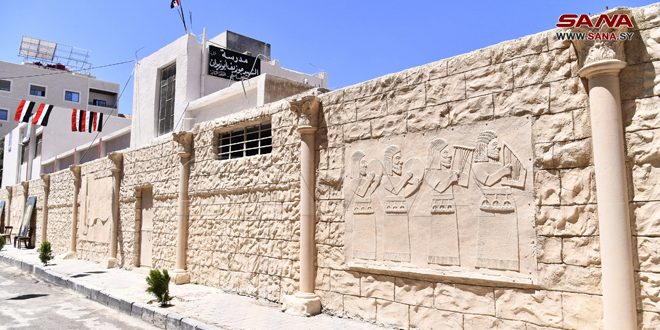
Over 40 days, a number of plastic artists executed six murals that speak of historical symbols from Syrian civilizations, which they carved and painted on the wall of the Martyr Joseph Abu Zeidan School in Sahnaya in Damascus countryside.
The six paintings depicted a Phoenician ship, the Aramaic tambourine dance, the oldest Sumerian music found in Ugarit, the Assyrian warrior chariot, the Aramaic winged lion, and the Assyrian Hannibal’s guard.
In a statement to reporters, Minister of Education Dr. Darem Tabbaa pointed out that the presented plastic work sends a message to the world about Syria and its civilization and the role of community and voluntary work in shedding light on this civilization through national initiatives bearing human and intellectual values.
Regarding the details of the work, the director of the school, the plastic artist Nour Abdullah Rizk, indicated that the idea came in response to the devastation caused by the terrorist war on Syria, which systematically targeted Syrian antiquities. She noted that the paintings that talk about ancient Syrian civilizations aim to devote them to the younger generation through a visual reading of the sculptures, where each panel suggests a particular civilization.
Plastic artist Waddah Salama, Head of the Sculpture Department at the Institute of Applied Arts, highlighted the importance of integrating artistic work with volunteer work, especially in works that tell the story of Syria and its civilizational history. He noted that more than one material was used in the work, with care for the historical link between the civilizations documented by the paintings, thus it became one of the most important products made by the Syrian man throughout history.
The artist, Joanna Izoli, pointed out that the paintings collected by the mural were presented in a modern artistic style to contribute to introducing generations to the civilizations of their ancestors and the treasures of Syrian antiquities.
Inas Abdulka