
U.S. and EU Sanctions Are Punishing Ordinary Syrians and Crippling Aid Work, U.N. Report Reveals
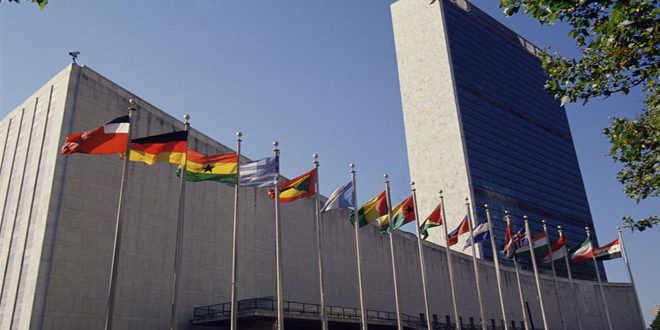
Internal United Nations assessments obtained by “The Intercept” have revealed that U.S. and European sanctions against Syria are punishing ordinary Syrians and crippling aid work in the country.
According to “The Intercept” website, the sanctions and terrorist attacks “have destabilized every sector of Syria’s economy, transforming a once self-sufficient country into an aid-dependent nation”. But aid is hard to come by, with sanctions blocking access to blood safety equipment, medicines, medical devices, food, fuel, water pumps, spare parts for power plants, and more.
The website clarified that in a 40-page internal assessment commissioned to analyze the humanitarian impact of the sanctions, the U.N. describes the U.S. and EU measures as “some of the most complicated and far-reaching sanctions regimes ever imposed.” Detailing a complex system of “unpredictable and time-consuming” financial restrictions and licensing requirements, the report finds that U.S. sanctions are exceptionally harsh “regarding provision of humanitarian aid,” the website said.
It added that U.S. sanctions on Syrian banks have made the transfer of funds into the country nearly impossible. Even when a transaction is legal, banks are reluctant to process funds related to Syria for risk of incurring violation fees. This has given rise to an unofficial and unregulated network of money exchanges that lacks transparency, making it easier for extremist groups like ISIS and al Qaeda to divert funds undetected. The difficulty of transferring money is also preventing aid groups from paying local staff and suppliers, which has “delayed or prevented the delivery of development assistance in both government and besieged areas,” said to the website.
It pointed out that trade restrictions on Syria are even more convoluted. Items that contain 10 percent or more of U.S. content, including medical devices, are banned from export to Syria. Aid groups wishing to bypass this rule have to apply for a special license, but the licensing bureaucracy is a nightmare to navigate, often requiring expensive lawyers that cost far more than the items being exported, it said.
It added Syria was first subjected to sanctions in 1979. More sanctions were added in subsequent years, though none more extreme than the restrictions imposed in 2011 on Syria.
“The Intercept” website went on to say that in 2013 the sanctions were eased but only in areas controlled by armed groups. Around the same time, the CIA began directly shipping weapons to armed groups at a colossal cost of nearly $1 billion a year, effectively adding fuel to the conflict while U.S. sanctions obstructed emergency assistance to civilians.
An internal U.N. email obtained by “The Intercept” also faults U.S. and EU sanctions for contributing to food shortages and deteriorations in health care. The August email from a key U.N. official warned that sanctions had contributed to a doubling in fuel prices in 18 months and a 40 percent drop in wheat production since 2010, causing the price of wheat flour to soar by 300 percent and rice by 650 percent. The email went on to cite sanctions as a “principal factor” in the erosion of Syria’s health care system. Medicine-producing factories that haven’t been completely destroyed by the fighting have been forced to close because of sanctions-related restrictions on raw materials and foreign currency, the email said, according to “The Intercept”.
Meanwhile, in cities controlled by “ISIS”, the U.S. has employed some of the same tactics it condemns. For example, U.S. airstrikes pounded the city of Manbij in northern Syria over the summer, killing up to 125 civilians in a single attack, “The Intercept” said.
H.M