
Trojan War- Heroes and Events Engraved on a Sarcophagus by Syrian Artist 1900 Years Ago
Dating to 1240 BC, the Trojan War took place in the far west of Anatolia between the Greeks and the Trojans. It is one of the most important wars in history not only because of its ten-year span and its subsequent historical impact, but also because of its extraordinary heroism and imaginative characters, making it exemplary of courage and sincerity throughout ages.
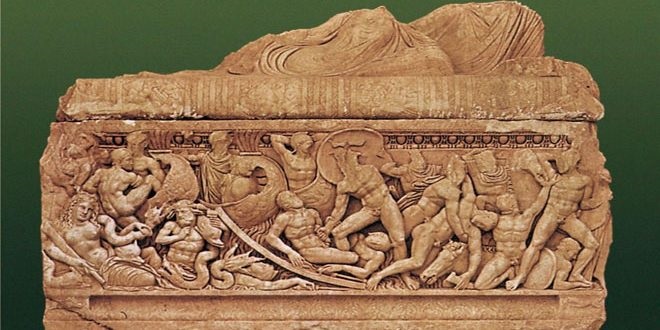
As an indication of our Syrian grandfathers’ openness to the others in old times, the Trojan war was engraved– by the creative old Syrian artist– in all its details and heroes on a second- century- AD sarcophagus found in the city of Rastan in 1977.
According to researcher Nasr Flaihan, the sarcophagus, currently on display in Damascus National Museum, was found inside a home in Rastan city. It is 70 centimeters deep, 220 centimeters long and 100 centimeters wide. It is composed of two pieces “the box and its cover” reflecting the old interaction of sculpturing arts in the Orient, particularly between Palmyra and its western counterparts. Four scenes were engraved on the sarcophagus, the most important of which is the scene of the sea & land battle in Troy.
Statues of a headless man and woman surmount the sarcophagus cover, and around them are lightly engraved local myths with symbolic motifs on the edges. It is believed that the statues belong to the Shamsigram family that ruled Rastan city at the time.
On the sarcophagus, we find the battle of Troy as described by Greek poet Homer in the Iliad. The center features Greek Achilles killing Trojan hero Hector, who was the king’s son and brother of Paris who kidnapped Helen, thereby causing the war between the Greeks and the Trojans.
The sarcophagus also features leader of the Greek campaign King Agamemnon, in his ship, and in the left corner is Poseidon, the god of the sea, and his wife, Amphitrite, each of them holding a sea serpent, while on the right corner is Artemis, the goddess of victory.
It is noteworthy that many archeological finds have been uncovered in Rastan, showing that this city dates back to the second millennium BC, according to a Hittite text, naming it as Arethusa, and that it has persisted throughout the Aramaic, Seleucid, Hellenistic, Roman, Byzantine, and Islamic periods.
Rayan Faouri