
The Tarboush, an authentic heritage of women’s traditional costume in Sweida Province
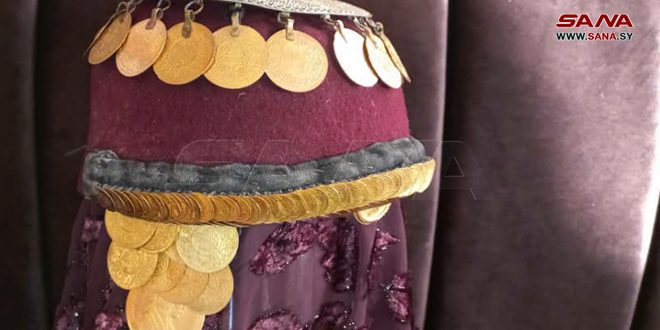
Why the women in Sweida province are so attatched to the Tarboush, regardless of all the time passed?!
The beauty of the traditional folk costume for women in the Syria city of Sweida is not complete without the “tarboush”, which many women are still keen to wear on wedding occasions, due to the specialty it carries associated with the authenticity of the heritage despite changing circumstances and the emergence of new clothing styles.
But why the tarboush is so close to the hearts of people in Sweida city ?
One day the “tarboush” was one of the ancient conditions of the dowry in the city, as it was worn by the bride on her wedding night, but this tradition declined with the change of circumstances, and became limited to those who inherited it from their mothers due to its high cost.
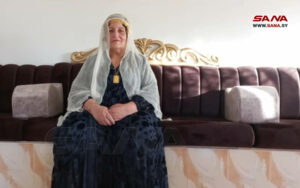 Basma Al-Shaibani, a woman from the countryside of Sweida, explained: The tarboush is one of the most ancient types of traditional ornaments, and it may sometimes be made of copper pieces, so it is traditionally called by our grandmothers, indicating that elderly women used to wear it padded, where a piece of black lace is placed over the golden pieces.
Al-Shaibani tells her story with the “tarboush” since she was young, as she narrates how she felt like a queen when she put it on her head and when she grew up, she designed one of crochet and silver to wear on her wedding day, as it still accompanies her to this day.
Another woman, Mrs. Shafiqa Nasr, from the town of Al-Mazra’a in the western countryside of the city, still keeps her “tarboush” which she made 32 years ago, as it carries symbolism because of its connectedness with heritage, so she and her daughters made sure to wear it and lend it to brides from other villages and towns
According to the researcher in heritage Salman Al-Badish, who explains more about the making of the “tarboush” and all accessories related to it the “tarboush” is made of red broadcloth, with the upper sharp edge that connects its upper part to its sides broken, in order to take the roundness and curvature appropriate to the woman’s head. Its height does not exceed 15 cm. It consists of four parts, including a decorated round silver sheet hanging from its circumference what’s called “Al-Jahayed”, which are circular golden pieces, and their number ranges between 25 and 35 pieces.
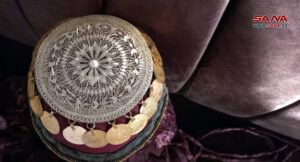 The second part, according to Al-Badish, it is the “Shakkeh” that is fixed on the forehead and it includes a number of gold pieces ranging betwee 60-80 pieces, while the third part, which also includes a number of gold pieces, each one of which is called “Qaranisa” hanging on both sides of the head. The fourth part is called “Al-Ghawazi” that includes hanging a golden piece from the front and center above the forehead, in a way that two-thirds of it appears from under the edge of the tarboush. Currently, the piece is being replaced by a golden lira.
Finally the last part of the tarboush consists of a piece of transparent white cloth called “the fouta” placed over the tarboush, as the head cover for women in the city.
But why the tarboush is not approached anymore by modern day brides of the city !?
The real reason is the fact that nowadays the traditional tarboush of Sweida city will cost a fourtune as most of it is made out of gold and silver! And with the financial crisis Syria and the Syrians are going through only a few, and even no one, can buy it for their bride !
Syria has a lot of inetesting heritage stories. Behind every piece it displays to the world, there is a symbol and meaning and the tarboush is just one of those magical pieces of our heritage.
Leen Al Salman