
The Syrian-Russian Ministerial Coordinating Committees: The practices of Western countries and their economic sanctions impede the return of the displaced and cause the suffering of the Syrians
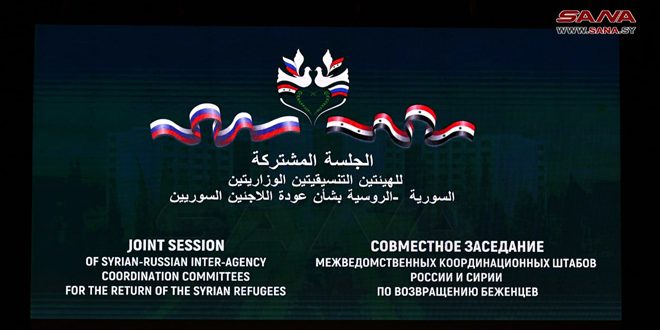
The two bodies said in a joint statement at the conclusion of the work of the Fifth Follow-up Meeting of the International Conference on the Return of Syrian Refugees and Displaced Persons at the Conferences Palace in Damascus, “On October 20, 2022, a joint meeting of the Syrian and Russian coordinating bodies was held in Damascus with the participation of a Russian delegation that included representatives of the presidential administration of the Russian Federation and 15 executive authorities as well as federal companies, government companies, 16 regions and 6 non-governmental organizations in the Russian Federation with the participation of their counterparts from the Syrian side. Representatives of the United Nations, the International Committee of the Red Cross and the Syrian Arab Red Crescent were also invited to the meeting in order to exchange views on a wide range of humanitarian issues whose solution requires coordinated efforts from the international community”.
The two bodies added: The efforts made for the return of the displaced and refugees are reflected in the statistics related to the return of Syrian citizens to their homeland and the restoration of normal life. So far, more than 2,413,527 Syrian citizens have returned to their homes, and thousands of facilities of social and industrial importance have been repaired and operated in different regions of the country since the year 2018.
The two bodies indicated that the Syrian government continues to develop the industrial, agricultural and economic sectors and provide support in various fields from issuing preferential loans to entrepreneurs and creating additional jobs for citizens returning to their homeland to direct use of the capabilities of Syrian administrations, which contributes to restoring the most important industries and infrastructure.
The two bodies stressed that the measures taken by the Syrian state to restore normal life create favorable conditions for the return of the citizens who forcibly left the country. More than 170 tons of humanitarian aid for various purposes have been delivered to needy Syrians.
The two bodies added: The federal executive authorities and organizations of the Russian Federation continue to work on providing humanitarian assistance for the reconstruction in Syria, and joint activities are being carried out in the field of trade, cultural heritage, industrial and agricultural development, and through the efforts of representatives of the Antiquities Rescue Center of the Institute for the History of Material Culture of the Russian Academy of Sciences and the General Directorate For Antiquities and Museums in Syria, work has been completed in the first phase of the restoration of the Arc de Triomphe in Palmyra, and the remaining phases will be followed up.
The two bodies pointed out the signing of a number of agreements in the main areas of Syrian-Russian cooperation, and a number of other agreements are being prepared for signature by the partners in the two countries, and the coordinated efforts of Syrian and Russian specialists have accomplished a wide range of tasks to activate the process of returning Syrian refugees and providing them with humanitarian aid.
The two bodies stressed that the practices of Western countries aimed at economic pressure on the Syrian state, violating its sovereignty and territorial integrity, imposing illegal sanctions and looting state resources, have significant negative effects on the return of the displaced and on the lives of millions of Syrians.
The two bodies drew attention to the continued deterioration of the general situation in the Rukban and al-Hawl camps, which are located in the Syrian territories occupied by the United States of America.
The two Syrian-Russian ministerial coordination bodies said: Washington continues to steal Syrian oil, as up to 66,000 barrels of oil are illegally exported per day from the territories occupied by US forces, which represents 80 percent of the production volume per day, and because of this the humanitarian situation remains difficult in the country where millions of Syrians face shortages of electricity, food and water.
The two bodies renewed Syria and Russia’s strong condemnation of the illegal presence of foreign military units on the territory of the sovereign Syrian state and the theft by the occupying countries of the natural resources of the Syrian people, and stressed that the United States and its allies create pretexts to avoid interaction with the Syrian state on humanitarian issues.
The two bodies indicated that the continuation of the cross-border aid delivery mechanism is a serious problem, as it does not meet the needs of all Syrians in accordance with UN Security Council Resolution No. 2642. It also allows the sponsorship of terrorist groups in areas outside the control of the Syrian state over the funds of the international community and only contributes to prolonging the crisis in Syria and harm the restoration of normal life in the country.
NR