
The Syrian heritage is embodied by dancing within the “Syria Rainbow” festival
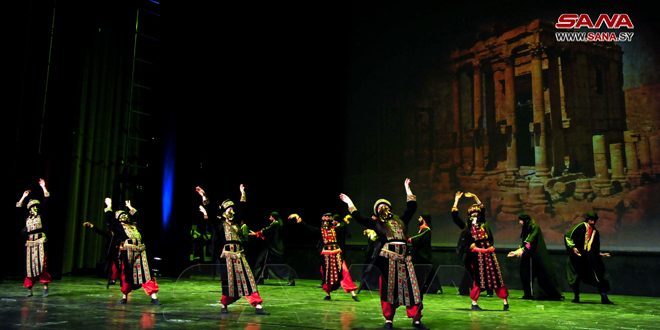
Through several dance segments that reflect the heritage of the Syrian dance with diverse roots, the Ministry of Culture held the “Syria Rainbow Festival” in its eighth session this evening, on the stage of the “Opera Theater” at Dar Al-Assad for Culture and Arts in Damascus.
The festival, which included five bands, formed a diverse artistic and dance mix, where the Damascene “Circassian Artistic Troupe” created its own dance, and the “Parmaya Troupe” coming from the city of Qamishli, presented the Syriac and Assyrian heritage.With regard to the Kurdish heritage, it was the “Ashti Troupe”, while the “Syrian Amal Dance Theater Troupe” presented some of the Syrian heritage, such as the coastal region and the Euphrates, while the “Karni Troupe” coming from Aleppo presented the Armenian heritage in its finest form.
Idris Murad, the supervisor of the “Rainbow” festival, said that the aim of the festival is to preserve and document the Syrian artistic heritage, in addition to being a window for the participating teams to transfer the heritage of their region and motivate them to continue with this idea, and develop it in reviving the Syrian intangible heritage to the public, and its transmission back into the light.
Murad pointed out that the festival is an opportunity to gather all Syrian components in their different languages, music, dances, and even costumes on one stage under one title, “This is Syria.”
In turn, Alaa Khalaf from “Ashti Band”, expressed her happiness to participate, as she and her band performed three dances, “Sibani”, “Sorani” and “Kafuki”, which symbolizes the ancient heritage.
It is noteworthy that “Rainbow” is an annual festival, which started eight years ago, in which artistic performances are presented by a number of Syrian bands.
NR