
The Syrian Government holds the 1st Conference for Investment in the Electricity and Renewable Energies
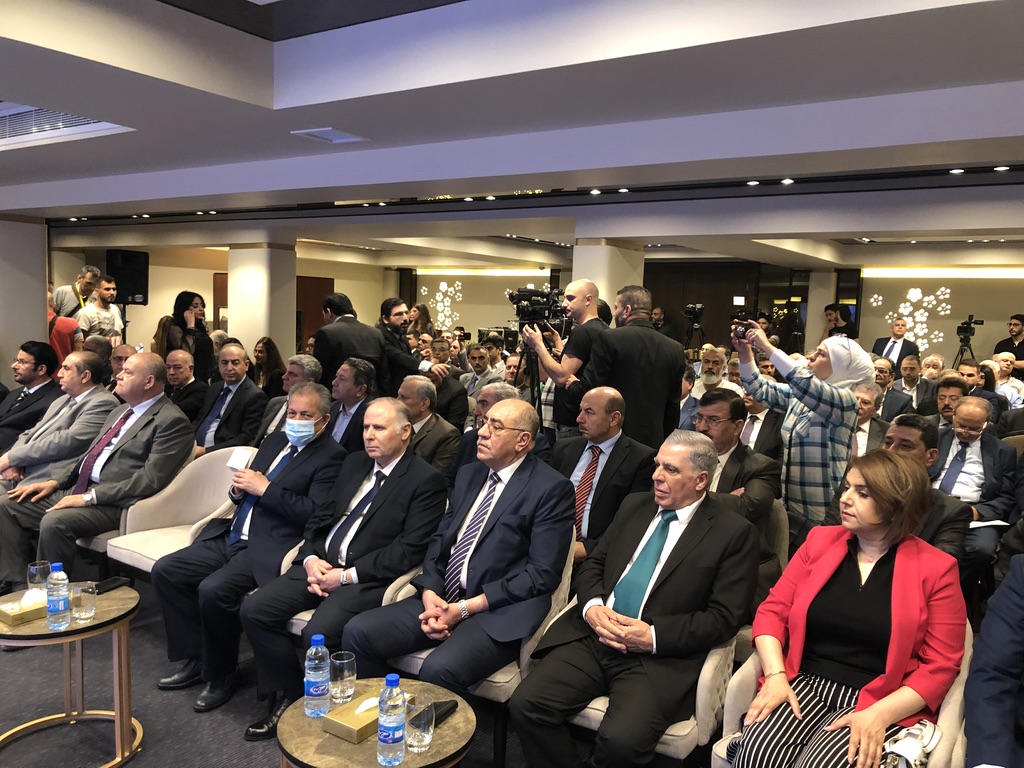
On May 15th, the Syrian government held the 1st Conference for Investment in Electricity and Renewable Energies with wide participation of private and public organizations and companies at the Jasmine House Hotel in Mezze, Damascus.
The Prime Minister, Eng. Hussein Arnous and Lebanese Minister of Energy and Water Walid Fayyad participated in the opening ceremonies.
The Minister of Electricity, Eng. Ghassan Al-Zamil made an opening speech in which he said that the ministry is working to encourage and support public and private investment in the field of renewable energies through policies or legislation.
The Minister of Electricity, Eng. Ghassan Al-Zamil said that the electricity sector was one of the sectors most targeted by terrorist groups and their sabotage practices during the one-decade war against Syria.
“The terrorist groups attacked the electricity infrastructure, cables, transporters and power plants in the first months of war against Syria .This caused a decline in the quantities of electricity generated from 50 billion kilowatt-hours in 2011 to 17 billion kilowatt-hours in 2022,” Minister Al-Zamil said in the Conference which was attended by Syria Times.
 “The government has developed a road map to create an ambitious investment environment through short, medium and long-term strategies in a way that can attract real and serious investors and grant them all possible privileges and facilities,” Minister Al-Zamil said.
“Pre-2011, Syria approached the production of 400,000 barrels per day of oil, and it used to consume half of the quantity, and export the rest. Today, production has fallen to only 20,000 barrels per day because the American occupation occupied our oil fields in northern Syria,” Minister Al-Zamil said.
The Deputy Minister of Electricity for Organizing Electricity Affairs, Dr. Eng. Sinjar Toa’amah spoke about the importance of private investment and cooperation between the public and private sectors to develop the electricity sector in Syria.
“All the obstacles were reflected in the duration of the electric supply with increased blackouts to 12 hours compared to one hour of power supply in the countryside,” Dr. Toa’amah said.
Toa’amah spoke about the existence of a large gap between the costs of electricity production and the costs of selling it, in addition to the suffering of companies operating in this sector and their need for foreign exchange.
The Director of Planning and International Cooperation in the Ministry of Electricity Eng. Adham Ballan presented the national strategy to invest in renewable energies, which aims to increase the contribution to the energy balance on both the demand and supply sides.
“The statistical data of electrical production and consumption before 2010 shows that electrical production reached 46.2 billion kilowatt-hours, and fuel consumption reached 3.8 million tons. In 2020, Syria produced 23 billion kilowatt-hours of electricity and 1.6 million tons of fuel,” Eng. Ballan said.
 The Director of Electricity Sector Regulation, Dr. Muhammad Bassam Darwish, talked about the legislation governing investment in the electricity sector, which encourages investors to establish projects for the generation and distribution of electricity and renewable energies.
After the ceremony’s speeches, the Minister of Electricity, Eng. Ghassan Al-Zamil headed an open discussion session with the participation of the Director General of the National Center for Energy Research, Dr. Eng. Younis Ali, Deputy Minister of Electricity for Organizing Electricity Affairs, Dr. Eng. Sinjar Toa’amah, the Director of Electricity Sector Regulation, Dr. Muhammad Bassam Darwish and tv anchor Khalid al-Haswany.
Ghassan Khalifah, a businessman from the city of Hama, who runs a private-own solar energy station spoke about the private investors’ demands from the government including allowing them to import cars and trucks for their solar panels projects in addition to increasing the purchasing prices of produced electricity after the increase of international prices due to the Russian-Ukraine military operation.
“This Conference is a very important step to gather private investors and governmental officials to discuss all issues of renewable energy and how to solve all obstacles and problems,” Fahad Badawi, a Syrian investor in solar energy, said to Syria Times.
 “I believe that the Syrian private investors are moving from importing the solar panels, investors and batteries to producing them inside the country. For now, there are three factories working on the solar panels, a governmental Solaric Factory in Damascus, a second private-own factory in the Industrial City of Hassya in Homs and a third one underbuilding in Latakia city. These three factories will produce high-quality solar panels and later they will produce inverters for factories and big facilities,” Badawi said during a meeting on the sideline of the Conference.
“We came from Jordan to participate in this important conference,” General manager of the Jordan TERA WATT Company, Eng. Saleh Atiyat said to Syria Times.
“We hope to find a Syrian partner to have cooperation in the field of production and marketing because Syria is a big market and we want to have good business with this country,” Eng. Saleh Atiyat said.
The two-day Conference was held under the slogan “Investment in Renewable Energies and Electricity.The Engine of Sustainable Development in Syria” and included open discussion sessions with participation of ministers and senior government officials.
Reported by Obaida Hamad/ InasAbdulkareem
Photos by Obaida Hamad