
The Russian Coordination Center hands over to the National Museum in Damascus an artifact dating back to the Assyrian era that was intended for smuggling
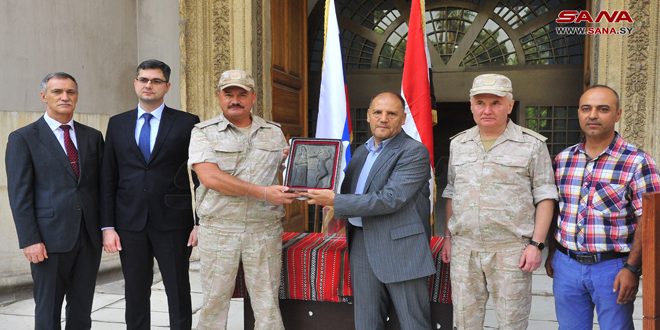
The Russian Coordination Center in Hmeimim handed over to the National Museum in Damascus an artifact dating back to the Assyrian era of the first millennium BC that was found in southern Syria.
The piece has archaeological, historical and artistic value and it was made of black basalt stone with inscriptions symbolizing strength.
It was found in the south of Syria in one of the archaeological sites in the northwest of the country.
It was excavated by illegally armed terrorist groups to be smuggled and sold outside Syria.
“During our presence on the good Syrian land, we saw what terrorism did to it in terms of aggression and encroachment on its monuments and sanctities,” the commander of the Russian Military Police in Syria, General Dmitry Scherbanov, said during the handover of the artifact.
He stressed that they worked to conceal its historical, Islamic and Christian landmarks and everything they touched.
He pointed out that after the return of security and peace to Syria, it must restore its monuments and everything related to its civilization and heritage.
Director General of Antiquities and Museums Nazir Awad indicated that receiving this artifact from the Russian side, which was intended for smuggling outside Syria, is an exceptional event.
Awad said that the piece will be subject to further study and analysis to reveal more accurate information about it.
Awad indicated that this event is an affirmation of how seriously Syria takes the return of antiquities to the National Museum in Damascus, especially that the piece returned to its rightful owner, the Syrian people.
The Assistant Director General of Antiquities and Museums, Dr. Hammam Saad, pointed out that the majority of the artifacts that were stolen were through the illegal excavation of archaeological sites.
He added that this piece was stolen as a result of the illegal excavation of an archaeological site, where the Russian forces found it in the area of southern Syria.
For his part, the Chargé d’Affairs of the Russian Federation Embassy in Damascus, Eldar Kurbanov, pointed out the importance of cultural cooperation as an important part of the bilateral cooperation between the two countries.
Inas Abdulkareem