
The Nanshan Museum in Shenzhen, China, continues to display Syrian monuments
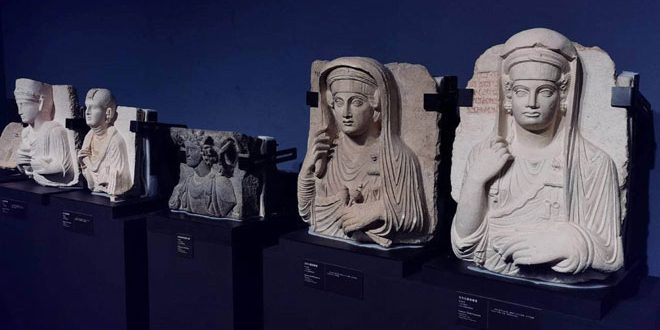
Based on an agreement between the Directorate General of Antiquities and Museums and the Foundation of Art Galleries of China, and with the support of the Syrian Embassy in Beijing and the China National Cultural Heritage Administration, a large number of artifacts were loaned to the Chinese side to be displayed at the Nanshan Museum in Shenzhen City, as a part of a tour to show Syrian antiquities in a number of Chinese cities.
The exhibition, which opened on the 4th of August, includes a large number of artifacts from nine Syrian museums that have different geographical origins representing a number of diverse and deep-rooted Syrian civilization and heritage dating back to successive historical stages. The artifacts in this exhibition were arranged into four sections dedicated to each of these stages, as well as a special section featuring the historical exchange between Syria and China on the Silk Road.
The director of the Nanshan Museum, Chi Sen, told the SANA correspondent in Beijing, “Shenzhen City is alive and beautiful while Nanshan Museum is modern and it is so important to be the first place to display the collection of Syrian cultural monuments.
Sen added: Syrian civilization is deeply rooted in history, and its capital, Damascus, especially the old city, is well known worldwide, pointing out that this exhibition is the first major exhibition of Syrian cultural antiquities in China, and is the first to introduce Syrian history and civilization.
 The Cultural and Media Affairs Official at the Syrian Embassy in Beijing, Dr. Fadi Wassouf, indicated that the exhibition of Syrian antiquities in China is a distinguished step to enhance civilizational and cultural exchange between the two countries and reflects the two sides’ continuous desire to develop cooperation relations at all levels.
He pointed out that, despite the obstacles caused by the spread of the Corona epidemic and the accompanying travel restrictions, both sides had been able to overcome those obstacles and set up the exhibition, which provided an additional indication of the two countries’ constant determination to expand the prospects for cooperation and develop common ties.
The exhibition runs until 7 November before moving to its second stop at the Jinsha Gallery in Sichuan province to give Chinese people a greater chance to see the Syrian relics.
The exhibition tour will continue in several Chinese cities for two years, allowing more Chinese citizens to learn about the history and civilization of Syria.
 Amal Farhat