
The Guardian: EU Plans to Buy Syrian Oil From Armed Groups Aim to Fund Al-Qaeda
LONDON – The EU decision to lift sanctions on Syrian oil to buy it from the armed groups in Syria so as to help them consolidate their position on ground, has accelerated a scramble between these groups for control over wells and pipelines in Syrian areas, according to the British “The Guardian” newspaper.
In its report on Monday, the newspaper said that Jabhat al-Nusra, affiliated with al-Qaida and other extremist groups, has illegally controlled the majority of the oil wells in Deir Ezzor province, displacing the local population by force. They have also been seeking control of other fields in al-Hasakah governorate, north-east Syria.
The daily pointed out that the armed terrorist groups have turned their guns on each other in the battle over oil, water and agricultural land.
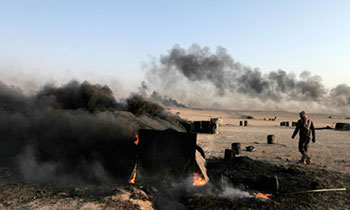
As a result of the armed groups’ rush to make quick money, open-air refineries have been set up in Deir Ezzor and al-Raqqa provinces. Crude is stored in ditches and heated in metal tanks by wood fires, shrouding the region with plumes of black smoke, exposing the local population to the dangers of the thick smog and the frequent explosions at the improvised plants, the newspaper said.
It added that heating oil, diesel and petrol is condensed in hoses running from the tanks through pools of water and sold across the north, as far as Aleppo. The remaining crude is shipped by road on tankers to Turkey.
The Guardian noted that the EU announced it was lifting its oil embargo in April to help what it called the “moderate opposition”, but some experts say that the announcement intensified the western-backed armed groups race for oil.
According to the newspaper, Joshua Landis, an expert on the region at the American University of Oklahoma, said the EU decision on oil led to a logical conclusion from this craziness, which is that Europe will be funding al-Qaida itself.”
“Jabhat al-Nusra is investing in the Syrian economy to reinforce its position in Syria and Iraq. Al-Nusra fighters are selling everything that falls into their hands from wheat, archaeological relics, factory equipment, oil drilling and imaging machines, cars, spare parts and crude oil,” Abu Saif, Muslim Brotherhood-linked person, told the Guardian by phone from the Deir Ezzor area.
 Syria’s Foreign and Expatriates Ministry has sent two identical letters to the UN Chief and President of the Security Council, in which it described the EU’s decision to lift the embargo on Syrian oil exports to allow armed groups to sell it, as unprecedented aggression and as a violation of international laws and UN charter.
On Monday, British Foreign Minister William Hague said that “the EU must reconsider the arms embargo on Syria though the EU hasn’t adopted an immediate decision on the issue of arming the opposition in Syria.”
Reuters quoted Hague as saying: “We must make clear that if the regime does not negotiate seriously at the Geneva conference, no option is off the table.”
France and Britain have failed more than once to convince the EU to supply the armed terrorist groups in Syria with weapons through lifting the embargo on sending arms to the armed opposition.
On the other hand, Austria has recently rejected the French and British calls for lifting the EU’s embargo on arms supplies to the armed groups. The Austrian president described these attempts as a violation of EU laws.
H. Mustafa