
The Global Justice organization honors U.S. Ambassador-at-Large for War Crimes Issues Stephen Rapp in Damascus
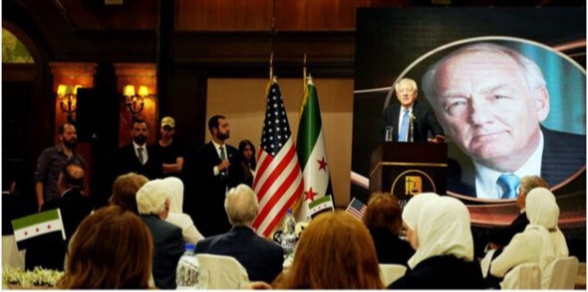
The annual Global Justice Award conference was held today to honor U.S. Ambassador-at-Large for War Crimes Issues, Stephen Rapp. The event was organized by Global Justice under the title “Building a Just, Peaceful, and Democratic Syria,” and took place at the Seven Gates Hotel in Damascus.
In her speech, Minister of Social Affairs and Labor, Hind Qubuat, praised Mr. Rapp’s significant efforts in supporting justice in Syria and exposing the regime’s crimes against Syrians. She announced that, in honor of the regime’s victims, a hospital would be established in the name of Dr. Majd Kam Almaz, who was killed in the regime’s prisons, and a youth and detention survivors support center would be named after Mazen Hamada, who was tortured and killed like thousands of others in the regime’s prisons.
For her part, Maysa Qabbani, Deputy Head of Global Justice, stated that the new free Syria takes pride in all its sons and daughters who, over the years of the revolution, gave their utmost to support their country, whether inside Syria or abroad—including civil society organizations. She noted that expatriates, including those residing in the United States, returned to Syria after liberation to help rebuild the country.
U.S. Ambassador Stephen Rapp, in his remarks, highlighted the extensive efforts made to document the crimes of the former regime through cooperation with brave Syrians who risked their lives to expose these atrocities to the world. These crimes included torture and killings in prisons, arbitrary detention, enforced disappearances, sieges and starvation of communities, denial of medical access, use of chemical weapons, and violations of the Geneva Convention. He stated that the crimes of the Assad regime are among the worst committed in the current century, carried out under international silence.
Rapp emphasized that these crimes have been documented far more thoroughly than those committed by the Nazi regime during World War II. He noted that years of documentation efforts led to prosecutions in some countries, resulting in the arrest of former regime officials who had been living in the U.S. and Europe.
Rapp added that the “Caesar” photos—which the regime denied but were verified by specialized institutions—played a critical role in supporting the international campaign that exposed Assad’s regime. He also cited the documentation of mass graves, supported by satellite imagery, and confirmed that there is willingness to cooperate with the Syrian government and authorities to pursue justice through continued documentation of crimes, uncovering the fate of the forcibly disappeared and mass grave victims through DNA testing, and holding those responsible accountable.
The event also featured a presentation on the organization’s key projects in Syria in areas such as economic, political, and healthcare support and empowerment, efforts to lift sanctions, building schools in camps, and more. At the conclusion, a commemorative shield was presented to Ambassador Stephen Rapp.