
The Damascene Oud Part of the Syrian Musical Heritage
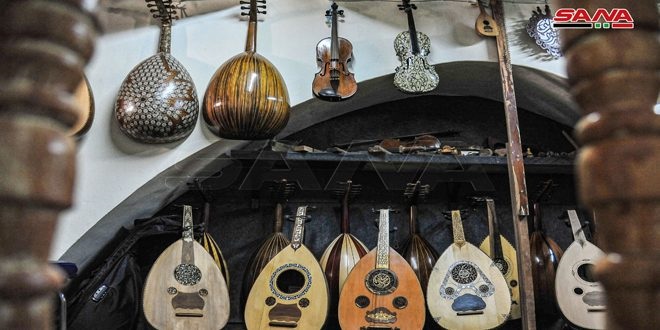
The Damascene oud is one of the most important components of the Syrian intangible cultural heritage and has an international reputation characterized by its precise handicraft and smooth sounds that generate original music. The oud is one of the oldest oriental instruments and Syria considered its cradle.
Historical archaeological evidence was found in northern Syria dating back 5,000 years, which contained stone inscriptions representing women playing this instrument. The oud used to be a main instrument in many rituals and occasions and played a key role in bringing Syrians together.
 Sarouja neighborhood has been associated with the minds of those who love Damascus for its beauty and originality. The neighborhood’s residents narrate the ancient musical heritage which is located in a small lane known as the Rose Alley.
It embraces a workshop for the manufacture of oud that makes passers-by stop at the tunes emanating from it and are motivated by curiosity to enter it.
The workshop was set-up as a humanitarian development project for “Al-Wafa” Development Association in the form of an incubator for the craftsman Bashar Jawdat Al-Halabi, whose workshop was destroyed during the years of the terrorist war on Syria.
 The craftsman Bashaar ‘s learning of this profession began with his father, the late Damascene oud maker, Jawdat al-Halabi.He established his first workshop in Lebanon in 1990, followed by his second workshop in Darayya region. But after it was destroyed during the war, Al-Halabi moved to his home and obtained the support of the Association Al-Wafa, which is interested in reviving heritage professions and helping craftsmen whose workshops have been damaged by terrorism.
Talking about his choice of the Rose Alley as a place for his workshop, Al-Halabi told SANA that this place has embraced the Damascus oud industry since 1920, when it appeared as an extension of Al- Qaymariyya neighborhood from which most of the Damascene oud makers started.
The most exalted skillman Bashar combines in his workshop between the restoration of old ouds and the manufacture of modern ones. He also keeps a large group of oud makers and the late Grand Master (Sheikh Al-Kar) Abdo Nahat dating back to the years 1900 and 1913. He also worked on repairing the oldest oud made by a sculptor dating back to 1881.
He stressed his passion for this industry , which he tries to revive again , preserving its basic character and shape, taking into account his choice of the oldest types of wood while imitating the old shape with its decorations and models, and most importantly with the oud mold and its own voice.
Although AlHalabi’s workshop is small , it is now fully equipped and includes all stages of the oud industry.
Bashar uses rose, poplar, ebony and apricot wood in the manufacture of oud, which Damascus Ghouta was famous for, but the walnut wood is mostly used , due to its malleability, its gradual colors and the sound produced by it, which is considered one of the smoothest sounds.
Al-Halabi has transferred this craft to his son Khaled, who established his own workshop in Canada to highlight the fact that the Damascene oud is unique and competes with all the ouds of the world.
He underscored that despite the existence of different schools of oud making to embody the identity of their countries such as Iraq, Egypt, Iran and Turkey, the Damascene school is the one that owns the basic Eastern music secrets.
Bashar still preserves his father’s memorial card written by Mrs. Umm Kulthum , which she presented to him in 1955 on the occasion of making her a special oud . He pointed out that the oud is currently showcased in Umm Kulthum’s museum in Cairo.
The Syrian craftsman Al-Halabi expresses his hope to establish specialized vocational schools that teach the basic principles of this industry. He stressed the younger generation that wishes to learn it, must enjoy patience, perseverance and passion in learning it.
Rawaa Ghanam