
The Cyprus Problem -Part II
Constitutional Collapse 1960-1974
A famous expert on constitutional law described once the Cypriot constitution as “unique in its tortuous complexity. “Within a short period of time, the first disputes started to arise between the two communities. Issues of contention included taxation and the creation of separate municipalities. Also, the legislative veto system resulted in a lockdown in communal and state politics. The biggest tension started when president Makarios proposed a set of 13 constitutional amendments which were immediately rejected by Turkey and the Turkish Cypriot leadership. In 1963, fighting erupted between the two communities, resulting in the death of 364 Turkish Cypriots, 174 Greek Cypriots. The power-sharing government collapsed. In March 1964, a United Nations peacekeeping force was formed following the UNSC resolution 186. In 1967, a military coup took place in Greece which led to a fundamental redefinition of Greek Cypriot objectives. Makarios announced a new policy stating that “What is feasible does not always coincide with what is desirable”5 This new policy which meant abandoning the long-standing goal of “enosis “was confirmed with the vast majority in the presidential elections of 1968. At last, Cyprus was moving along with the lines of pragmatism and a promising future was foreseen. A series of intercommunal talks were held under the auspices of the United Nations in the period between 1968 and 1974. The talks achieved some progress. The major problem at that time was the escalation of the clash between Makarios and the Greek junta
. On July 13, 1974, two constitutional experts from Greece and Turkey finalised a draft for a comprehensive settlement of the Cyprus problem which was to be ratified on July 16, 1974, by the two negotiators Clerides and Danktash. This agreement was on the basis of a unitary state with elements of local and communal self administration on issues of low-level politics, aimed at overcoming the stalemate following the 1963 constitutional and intercommunal crisis. Tragically, the coup of July 15, 1974, reversed this historical path. The crisis in 1974 was in essence the culmination of foreign interventions in Cyprus. The Greek junta overthrew president Makarios on July 15, 1974; indeed, the clash between Athens and Nicosia was out of control and with repercussions that extended beyond the island state.
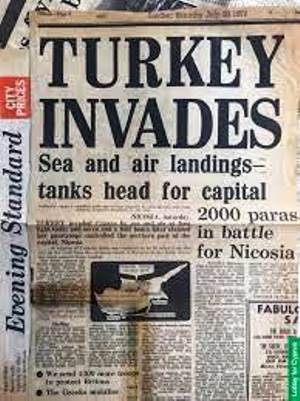
It should be noted that several analysts have argued that the Greek coup against Makarios was supported and even instigated, by the CIA.7 Makarios escaped the country with British help. The Greek junta appointed “Nikos Sampson” “the enosist “as president. This appointment meant that the declaration of enosis was imminent. Also, it meant that the Turkish invasion of the island was imminent too. Just after 6 o’clock in the morning, on July 20, the Turkish troops invaded Cyprus and captured 36% of the island. Cyprus became a divided island. The UN administered a buffer zone or a green line.
The invasion and division of the island had a profound effect on both communities. But for the Greek Cypriots, the effects were particularly catastrophic. “On July 23, the Greek junta collapsed both in Greece and Cyprus. Clerides-as a speaker of the House of Representative assumed duties of acting president. He immediately suggested to the then Turkish Cypriot leader R.Danktash the return to the 1960 Constitution. Danktash and Ankara declined. By August 16, 1974, there was a new political landscape in Cyprus. Turkey had captured 38% of territory of the Republic of Cyprus, which was ethnically cleansed from the presence of about 200,000 Greek Cypriots, who became refugees in their own country. The Turkish Cypriots who were more or less normally distributed throughout the island were gradually transferred to the Turkish occupied area. The Turkish military occupation continues to this day, under the pretext that military presence is necessary to guarantee the safety of Turkish Cypriots.
Reem Haddad
Editor-in Chief