
The current status on the Syrian intangible cultural heritage discussed in workshop
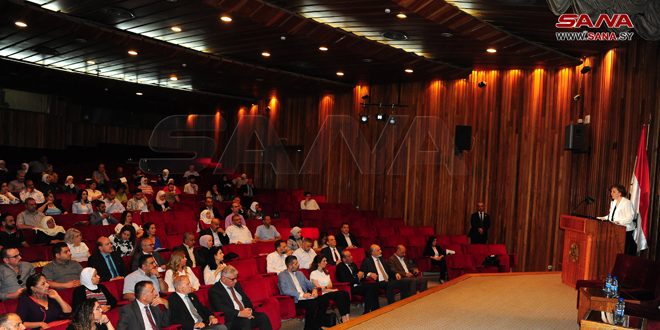
On June 27th, the Ministry of Culture – Directorate of Intangible Heritage organized a workshop on the Syrian intangible cultural heritage at the Al-Assad National Library in Damascus.
In a speech during the opening of the four-day workshop, the Minister of Culture, Dr. Lubana Mushawah, said: “What unites us today is our fear for our heritage -fear of tampering, theft and extinction, and our keenness to highlight our heritage , develop it and promote it, because of our deep belief that despite its diversity, its different practices, its sources, its paths and its privacy it forms an important and essential part of our unifying national identity.”
Dr. Mushouh pointed out that our heritage is rich and is the product of successive civilizations with deep roots, indicating that in addition to official bodies, there are non-governmental bodies, organizations and associations from the civil society concerned with heritage affairs.
Dr. Mushouh said, “Our problem today lies in the large number of parties, the scattering of efforts, the absence of a legislative framework that protects the intangible heritage from tampering, distortion and loss.”
The Director of the Directorate of Intangible Heritage in the Ministry of Culture, Rola Aqili, reviewed the work of the Directorate during the past years and what it is currently doing in its departments.
The first session of the workshop dealt with the current reality of the intangible cultural heritage in Syria, with the participation of the Director General of Antiquities and Museums, Nazir Awad, and from the Living Heritage Program in the Syrian Trust for Development, researcher Reem Ibrahim, head of the History Department at Damascus University, Dr. Imad Al-Nahar, and the musician Ghada Harb, directed by Firas Al-Qadi.
The second session discussed the legislative environment of cultural and intangible heritage in Syria, with the participation of the Legal Adviser at the Ministry of Culture Bashir EzzEl-Din, researcher Khaled Fayyad, from the Living Heritage Program at the Syrian Trust for Development Sherine Naddaf, and Director of Legal Affairs at the Directorate of Antiquities and Museums Ayman Suleiman and directed by Dima Nassif.
The workshop continues its sessions tomorrow, Tuesday, by focusing on two axes, the first being the risks and threats facing the intangible cultural heritage in Syria, and the second the opportunities and challenges in the field of the Syrian intangible cultural heritage.
O. al-Mohammad