
Terrorist Attacks on oil and gas facilities in Syria’s Homs coincide with so-called US “Caesar Act”
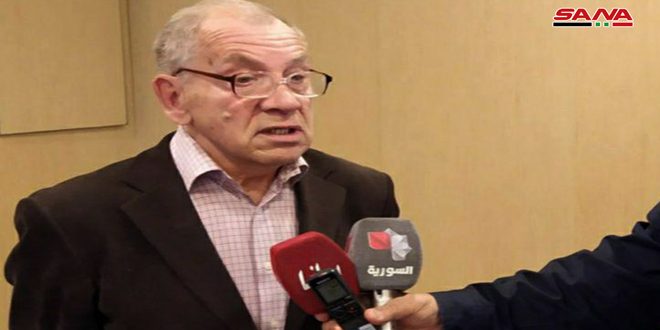
MOSCOW, (ST)- Senior researcher at the Russian Foreign Ministry’s International Relations Institute Yuri Zenin has described the terrorist attacks which targeted Homs oil refinery as well as a gas plant to the south of Syria’s central region and the al-Rayan gas station as “a systematic act of vandalism” that coincides with the so-called “Caesar Act”, a US legislation that imposes coercive economic sanctions on the Syrian people.
In a statement to SANA correspondent in Moscow on Saturday, Zenin affirmed that the parties behind these blatant attacks aim at harming the Syrian civilian population through depriving them from heating fuel as winter comes”.
“This cowardly attack comes as an act of revenge following the recent successive defeats of the terrorists, particularly in Idleb,” the Russian researcher said.
He added that the masterminds of the attacks are encouraged and incited by the US policies which keep violating the rules of the international law by stealing Syria’s oil fields and green lighting Syria’s enemies to bombard civil targets in the country under the pretext of the so-called US “Caesar Act”.
Egyptian MP: Washington’s anti-Syria measures aim at hampering the progress of the Syrian Army in the fight against terrorism
 In the same context, the Egyptian Parliament member Yusri al-Asyouti condemned the recently approved US law called “Caesar Act”, stressing that it aims at hampering the progress of the Syrian Arab Army in its battle against terrorism. He described this law as unacceptable and unjust
Al-Asyouti told SANA correspondent in Cairo that the Syrian state is fighting terrorism and pushes its danger away from the Arab region, pointing out that the Egyptians and the Syrians are one people and that any threat to one of them is a threat to the other.
The Egyptian lawmaker lashed out at last night terrorist attacks which targeted Syrian oil facilities in the city of Homs, emphasizing that the new attacks also come within the framework of the terrorist scheme which aims at undermining the potentials of the Syrian state.
Hamda Mustafa