
Tell Brak
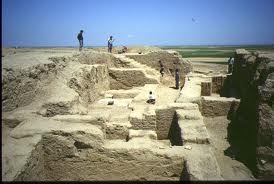

Tell Brak is situated in the Upper Khabur of north eastern Syria. It is one of the largest ancient hills in northern Mesopotamia, over 40 m high, 800 x 600 m in area, with an extensive outer town including a corona of smaller tells surrounding the main tell. As a ‘Gateway City’, Brak controlled one of the major roads leading from the Tigris Valley north to the metal sources in Anatolia and west to the Euphrates and the Mediterranean. The tell itself was occupied from at least as early as 6000 BC to the end of the Late Bronze Age , with settlement of ‘Ubaid to early Islamic date also attested in the outer town. Excavated areas of the site up to now date from the mid-fifth to the end of the second millennium BC. The earliest identified non-residential structure at Tell Brak is what must have been an enormous building, even though only a small portion of the room has been excavated. This building has a massive entranceway with a basalt door-sill and towers on either side. The building has red mud brick walls which are 1.85 meters thick, and even today stand 1.5 meters tall. Radiocarbon dates have placed this structure securely between 4400 and 3900 BC.
A workshop of craft activities has been identified at Tell Brak, as has a large building which contained mass-produced bowls and a unique obsidian and white marble chalice held together with bitumen. A large collection of stamp seals and so-called ‘sling bullets’ were also recovered here. A ‘feasting hall’ at Tell Brak contains several very large hearths and a quantity of mass-produced plates.
Surrounding the tell is an extensive zone of settlements covering an area of about 300 hectares, with evidence of use between the Ubaid period of Mesopotamia through the Islamic periods of the mid-first millennium AD.
Nada Haj Khiddr