
Syrian woman produces Natural Silk bath loofah and seeks to revive craft of silk preparing and dyeing
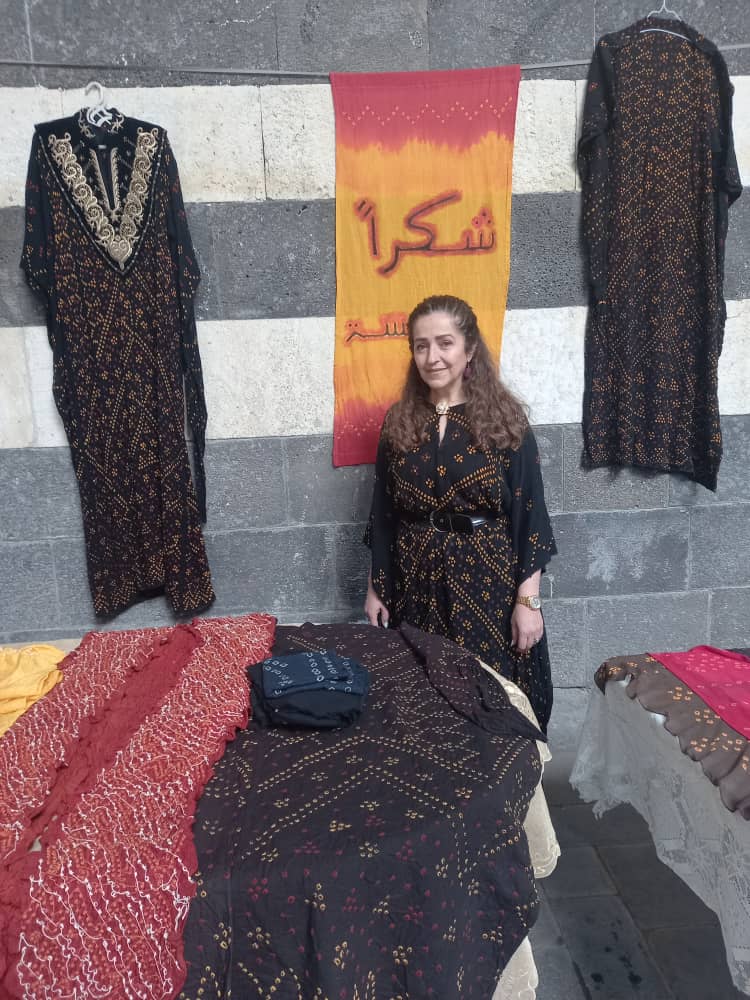
Since silk represents an essential part of Syrian culture and  its industries have been in huge demand all over the world for centuries, a Syrian woman produces Natural Silk bath loofah and seeks to revive one of the unique traditional craft in the governorate of Hama.
Mrs. Afaf Nabwani has introduced herself as a plastic artist , who studied at the faculty of Literature, and who is interested in silk and development projects.
“I like to  participate in silk projects. Silk has attracted me since my childhood….. My mother had silk fabrics and she would always explain  to me the importance of   Syrian silk which has unique characteristics and has won several prizes due to its high quality,” Mrs. Nabwani said in an interview with Syria Times.
She made it clear that in the past, the Syrian families in areas of the Orontes [or Asi River] , Damascus countryside, Homs, Aleppo, Lattakia and Tartous were breeding silk moths, and the number of breeders before the war was 25 – 30 in each area.
“In Drekish area, there were 30 breeders, while in Deir Mama area, all families were breeding moths.. The Ministry of Agriculture was distributing moths among breeders  for free  and was giving them 2000 Syrian Pounds for each kilo of cocoons. However, the number of breeders sharply declined now as there is no longer support for Sericulture, or silk farming…..This year, there are only 3-4 breeders in some areas,” Mrs. Nabwani added.
She went on to say: “ Due to the difficult circumstances that the country went through during the war, many people cut mulberry trees and planted lemon and olive trees to be a source of income as mulberry trees have become economically fruitless…. I am now working on an idea in cooperation with the Ministry of Agriculture for planting  mulberry saplings in Deir Mama area in Hama governorate or other areas.”
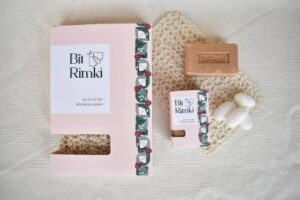
Natural silk loofah and soap

She hopes that she can save silk from dying out despite all challenges.
Her production, natural silk loofah and soap, could convey to the world a message about the beauty of the Syrian silk industry during the tough times that have taken a toll on all traditional crafts in the country.
In March 2022,  her leg was broken and she was forced to stay at home for 6 weeks. During this period, she  read a lot about the importance of silk protein to implement the idea of making loofah – an idea  that had popped up in her mind by the end of 2021 . So, she decided to make a small bath glove  based on her research ..
“When I used the glove, I felt that it was interesting. . Therefore, I coordinated between a person from whom I buy silk thread and fabric and another one,  who is producing cold process soap in a professional way , with the aim of making silk soap. I was sure that we could do it. We can make such productions which are rare all over the world.  We made it and its effects are awesome,” Mrs. Nabwani declared.
She has developed the loofah with the passing of time through filling it with cocoons to make it thicker so it can be used in a massage.
“ When hot water reaches the cocoons, they start to bring out protein that nourishes the skin. It is useful and I made an attractive package  for it with the help of designers. I am happy with this achievement…. Silk industry requires  support from all concerned parties as it can support the national economy,” Mrs. Nabwani clarified.
She pointed out that the loofah and soap are not available on the market yet.
“I give silk threads to a lady to make crochet and then I sew it by hand to make loofah….It takes 2 days to make one piece. I give soap to my friends and relatives,” Mrs. Nabwani said.
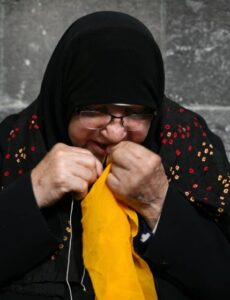
The 80-year-old woman Shamseh Bilal

A few months after her production of silk loofah,  she was informed that the 80-year-old woman Shamseh Bilal is the only one who still practices the unique craft of silk preparing and dyeing in Hama province.
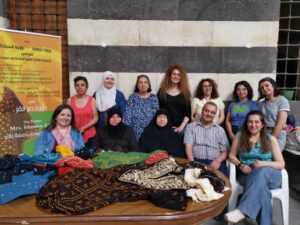
Mrs. Nabwani was afraid that this craft, which dates back to 300-400 years ago, would die out. For this reason, she contacted the Ministries of Tourism and Culture and merchants to hold a training course on this craft.
“The course was held from 17 to 27 May in 2022 in Damascus, and 12 trainees took part in it….The works of hajja (elderly lady, referring to Mrs. Shamsa Bilal) and trainees: shawls, robes and cotton towels,  were displayed in an exhibition held on the 28th  of May…. Several visitors, who came from Lebanon, bought some of these handmade works. I bought a robe made by hajja because I consider it as a piece of art that reflects the heritage of Syria… There are other robes for sale and the price of one piece is 4 million Syrian Pounds,” she said.
She noted that the beauty of this craft lies in the fact that it requires intelligence and planning and it brings several skills together. The process of this craft involves tying knots in raw silk fabric and then dyeing it with various colors to create patterns.
“We must be proud of this craft  and we must work on keeping it alive.. . I can not say that the craft is revived after this course , but it will not die out…We hope to hold another course in other governorates to enable the poor to survive,” Mr. Nabwani stated.
For centuries, brides across Hama used to receive a robe intricately designed using this method.
Trainees took part in training course on silk preparing and dyeing held in Damascus

“According to the traditions of  Hama’s residents, when a girl baby is born,  a robe is  made for her to wear when she becomes a bride. Some people used to attach  gold quarter liras to the end of the sleeves and make a belt and headband from Sarma and silk and hang gold quarter liras on them. A few families in Hama still preserve this tradition,” Mrs. Nabwani said, referring to the fact that during the Ottoman era, a piece of ‘Sarma’ fabric was added to Hama’s robe and it was embroidered with golden threads and worn by upper-class women.

She concluded by saying that one gram of silk was equal to one gram of gold in the past due to its importance.
 Proverbs related to silk are common among the Syrian public. One of them is : “ Better cuff a prince and steal his silky fabric, rather  than commit yourself with common people and cheap rags. ”
Interviewed by : Basma Qaddour
You might also like
.. _copyright: Copyright ========= .. code-block:: none Copyright (C) 1998-2000 Tobias Ratschiller Copyright (C) 2001-2018 Marc Delisle Olivier Müller Robin Johnson Alexander M. Turek Michal Čihař Garvin Hicking Michael Keck Sebastian Mendel [check credits for more details] This program is free software; you can redistribute it and/or modify it under the terms of the GNU General Public License version 2, as published by the Free Software Foundation. This program is distributed in the hope that it will be useful, but WITHOUT ANY WARRANTY; without even the implied warranty of MERCHANTABILITY or FITNESS FOR A PARTICULAR PURPOSE. See the GNU General Public License for more details. You should have received a copy of the GNU General Public License along with this program. If not, see . Third party licenses ++++++++++++++++++++ phpMyAdmin includes several third-party libraries which come under their respective licenses. jQuery's license, which is where we got the files under js/vendor/jquery/ is (MIT|GPL), a copy of each license is available in this repository (GPL is available as LICENSE, MIT as js/vendor/jquery/MIT-LICENSE.txt). The download kit additionally includes several composer libraries. See their licensing information in the vendor/ directory.