
Syrian woman Da’a Ni’emeh has 30- experience in restoring antiquities
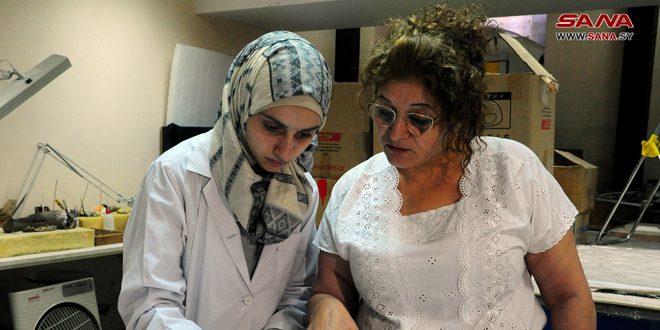
With the aim of preserving the cultural and historical deep-rooted Syrian heritage , the experienced Syrian woman Da’ad Ni’emeh has been exerting relentless efforts for thirty years in the field of restoring antiquities that passed through over the ages.
Ni’emeh is a graduate of the first batch of the Technical Institute of Archeology and Museums and has been working at the National Museum in Damascus since 1989. During these years, she worked at all restoration laboratories, including the restoration of metals, cuneiform figures, pottery, glass, murals, icons and organic materials.
The restoration and reviving antiquities, according to the veteran woman, is a sacred profession which is based on emotional relationship with these artifacts that are considered historical documents which must be presented in the most beautiful way to the whole world.
In an interview with the Syrian Arab News Agency (SANA), Ni’ehmeh praised the restoration laboratories of the National Museum in Damascus, as they have distinguished cadres trained by experts through missions sent outside Syria.
The Syrian woman , who is the wife of one of the Syrian Arab Army’s martyrs, added that the restoration process needs great efforts against huge destruction, which Syrian antiquities were exposed to during the years of the terrorist war on Syria .
Talking about the pieces that influenced her during her work, Ni’ehmeh said: “It is the restoration of a molded human skull dating back to the eighth millennium BC, after the discovery of two important sites, Tell Aswad and Tell al-Ramad , where molded skulls that were found needed special techniques in restoration.”
She stressed that the skilled restorer is able to restore what successive civilizations left in the hope that we will be able to restore life to Syria after the war it was subjected to, and that is only by promoting a culture of construction away from destruction.
The experienced woman expressed her wish to devote herself to documenting and publishing, and to write her own experience as she had sufficient knowledge of science and profession of restoration, in addition to the fact that she had benefited from the experience of ancient restorers.
She stressed that Syria’s strong will of life was and still the home of successive civilizations which must be preserved, immortalized and passed on to future generations.
Rawaa Ghanam