
Syrian pottery… a journey through the ages in an exhibition at the National Museum in Damascus
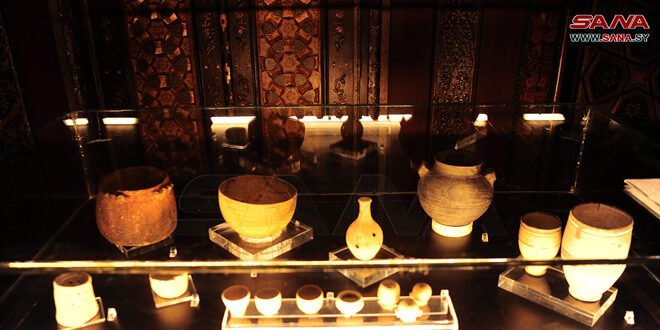
Given Syria’s richness in pottery, which appeared in the country10,000 years ago and has had historical and cultural importance, the Directorate-General of Antiquities and Museums held an exhibition entitled “Syrian Pottery Through the Ages” in the Sham Hall of the National Museum in Damascus.
The exhibition, which is part of the Syrian Culture Days, celebrated dozens of pottery pieces dating back to four different eras: prehistory, the ancient East, the classical eras, and the Islamic period.
The pottery pieces came in different shapes, colors, and sizes, carrying many connotations to tell the history of this ancient craft, which is one of the important aspects of Syrian civilization.
Minister of Culture Dr. Diala Barakat stressed the importance of this exhibition in order to introduce the importance of pottery throughout the Syrian geography and the stages of its development throughout the ages, in terms of the techniques and materials used in its manufacture and coloring, in addition to the drawings, decorations and writings on pottery pieces that embody the thought and creativity of the Syrian people throughout history.
Director General of Antiquities and Museums, Nazir Awad, indicated that the history of pottery in Syria is very ancient and begins when the Syrian man began to form pottery from clay with his hands, then this craft developed until he invented the wheel and began to make many pieces of pottery that are used for daily work, decoration and export as well.
In turn, Dr. Hiba Assi, curator of the Prehistoric Museum at the National Museum in Damascus, pointed out that the Prehistoric Section contains a model of the oldest types of pottery, in addition to seven pieces from the Chalcolithic period from different regions.
For her part, Dr. Nevin Saad El-Din, Curator of the Islamic Museum, noted that the Islamic section included 15 pottery pieces dating back to different eras, expressing the development of the pottery industry from the beginning of the Islamic period to the Ottoman period.
She indicated that during the Mamluk period, the pottery was decorated with the emblems of the Mamluk sultans. In this era, the pottery workshops spread in Damascus, Aleppo Hama and Raqqa. Later, in the Ottoman period, the nature of the manufacturing material, decoration, and manufacturing techniques developed.
Curator of the Classical Art Museum, Ali Habib, stressed that the classical period includes three periods: Greek, Roman, and Byzantine, while most of the displayed pieces date back to the Roman period.
He noted that the aim of the exhibition is to convey the cultural influence to society to acquaint it with the importance of the Syrians in uncovering the treasures of their country throughout history.
Najla Khoury