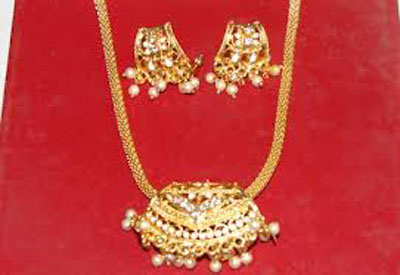
Syrian Folk Jewellery


  The ” folk jewllery” usually  means  the traditional  jewllery of the urban, rural and nomadic population  of  Syria, conceived as a cultural region.

Jewellery was the most important possession of all married women. It was given to them as part of their bride-price or in return for their contribution to the family income. Among peasants and nomads this payment in jewellery was made after the end of yearly economic cycle, while for the city-dwellers it depended on the results of the family business. If women themselves were active in business they invested their surpluses in jewellery.

Traditionally the most important material for jewellery was silver, but for poorer  people copper and bronze were also used. Silver gilt and gold were less common and used only in exceptional cases. Precious stones played no part in folk jewellery, but semi-precious stones occur occasionally. There are very few silversmiths still working in Syria, in Damascus and Deir ezzor. The silversmiths of Deir ezzor can only produce a very limited amount of work because the lack of their raw material, silver. The silversmiths still working today therefore basically restrict themselves to repair work. Syrian jewellery shows influences of Egyptian, Palestinian and Yemenite jewellery, as well as of jewellery from present-day Turkey, the Caucasus, Iran and Central Asia.

The folk jewellery of the region thus reflects Syria’s extensive trading contacts and the very heterogeneous composition of the Syrian population. The armlets and anklets especially show types similar to those found all over the Arabian Peninsula and beyond as far as the Arab-influenced East African coast- but there is no connection with the lewellery of Arab North Africa.                                                


Maysa  Wassouf


You might also like
Latest news
Muslim World League Welcomes EU’s Lifting of Sanctions on Syria as a Positive Step Forward Restoration Project of the Cultural Stairway Launched in Lattakia privince Syrian-Jordanian Agreement on Unified Fees… and 11 Weekly Flights to Damascus Jordanian Foreign Minister: My Visit to Damascus Was Fruitful Minister of Local Administration and Environment Discusses Cooperation with Swiss Mission in Damascu... Damascus Chamber of Commerce: lifting economic sanctions is a positive step toward rebuilding bridge... Jordanian Delegation to Visit Syria Next Week to Explore Economic and Investment Cooperation U.S. Secretary of State: Action must be taken at the congressional level to develop the private sect... Syrian , Turkish Defense Officials Discuss Enhancing Cooperation to Support Regional Stability Turkish Minister of Treasury and Finance: A Stable and Prosperous Syria Is a Major Gain for the Regi... Minister of Education Discusses Support for Education Sector with UK Minister for the Middle East Minister of Health Discusses Opportunities for Joint Cooperation with Head of Global Development at ... Syria , Jordan Sign MoU to Establish High Coordination Council Press conference for Minister of Foreign Affairs and Expatriates Al-Sheibani and his Jordanian count... UN , Saudi Arabia Sign Agreement to Rehabilitate Bakeries in Syria Minister of Health meets a number of his counterparts in Geneva Syria is among the world's top 10 pistachio-producing countries Foreign Minister Al-Sheibani Receives a  High-Level Jordanian Delegation in Damascus to Establish Jo... Kallas: We hope the EU will reach a decision today to lift sanctions on Syria Jordanian Foreign Minister Ayman Safadi Visits Damascus at the Head of a High-Level Ministerial Dele...