
Syrian Fisheries Sector is a Key Pillar of the Local Economy
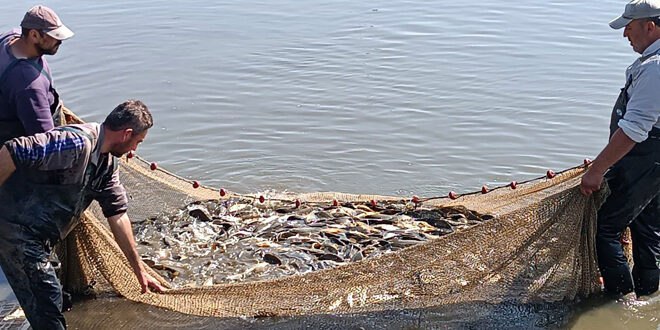
The Syrian fisheries sector is a key pillar of the local economy and food security as well as contributing to providing numerous job opportunities, especially with the shift toward fish farming and support for family farms.
SANA correspondent met with Eng. Hamoud Ghra’a, the Director of Production at the General Authority for Fish Resources Development to shed light on the state of the fisheries sector in Syria
.According to Ghra’a, the production quantities of marine and river fish farms in Syria in 2024 reached 10,085 tons, of which 9,900 tons were freshwater fish and 185 tons were marine fish. He pointed out that the most commonly farmed species in freshwater are “carp of all kinds, comb, catfish, and trout,” while in marine waters they are “shrimp” which are distributed at the governorate level.
Eng. Ghra’a pointed out that fisheries contribute to the local economy and food security by providing job opportunities for many citizens, distributed among a number of categories.
“The most notably of these categories, technicians, fisheries protection and monitoring workers, in addition to professional fishermen who work in territorial and international waters, including approximately 6,000 fishermen, in addition to more than 3,500 fishermen working in inland waters
He pointed to the workers in activities related to this sector, such as transporting and marketing production.
 Ghraa indicated that fish resources in Syria are exposed to a number of risks, the most important of which are climate changes that have altered the aquatic environment
Eng Ghra’a said that the government is developing strategic plans to support and develop this sector.
He stressed Ghraa that the Authority is seeking to rehabilitate its protection and monitoring points, and to coordinate with water resources to increase the water bodies that can be invested by the Authority, encourage marine fishing outside territorial waters as well as increasing the number of marine reserves.
Raghda Sawas