
Syrian delegation to a UNESCO conference highlights the impact of the unilateral coercive measures on the country’s education process
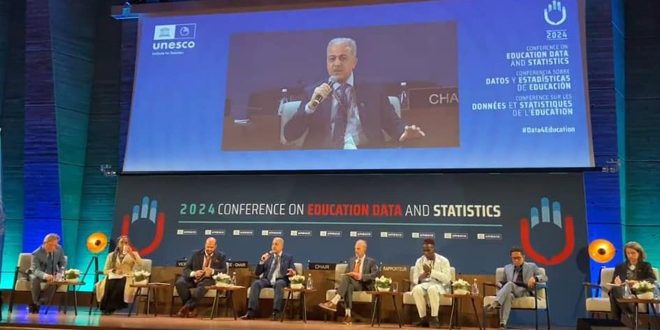
The Syrian delegation participating in the First UNESCO Conference on Educational Statistics, held in Paris, presented the Ministry of Education’s plan in the field of digital statistics and the transition to remote education, and ways to confront the current circumstances and the impact of unilateral coercive measures on the educational process.
The Syrian delegation, which was headed by the Assistant Minister of Education for Educational Affairs, Dr. Rami Al-Dhelli, and included the Syrian Permanent Representative to UNESCO in Paris, Dr. Louay Falouh, and the Head of the Social Statistics Department at the Central Bureau of Statistics, Manal Hammoud, gave a presentation on monitoring and follow-up work during a high-level session on the third day of the conference. The presentation included statistics on the reality of schools in Syria to determine the educational, administrative and student situation.
Dr. Al-Dhelli spoke about the steps of transformation in education that the Ministry worked to implement, especially with regard to distance learning, digital platforms, and virtual schools, and the focus on securing education for all students within an emergency plan that was adopted during the war, the Corona crisis, and the earthquake disaster, explaining that the most prominent difficulties were due to connectivity to network and the impact of unilateral Western coercive measures on the educational sector.
Education ministers and deputy ministers from several countries around the world participated in the conference, and representatives from regional organizations, United Nations agencies, the International Labor Organization, the International Monetary Fund, the International Telecommunication Union, the United Nations Development Program and UNICEF.
The conference also included sessions on using technology to collect, analyze and distribute educational data. During the conference, an educational robot supported by a database from the UNESCO Institute for Statistics was announced.
The Syrian delegation, which was headed by the Assistant Minister of Education for Educational Affairs, Dr. Rami Al-Dhelli, and included the Syrian Permanent Representative to UNESCO in Paris, Dr. Louay Falouh, and the Head of the Social Statistics Department at the Central Bureau of Statistics, Manal Hammoud, gave a presentation on monitoring and follow-up work during a high-level session on the third day of the conference. The presentation included statistics on the reality of schools in Syria to determine the educational, administrative and student situation.
Dr. Al-Dhelli spoke about the steps of transformation in education that the Ministry worked to implement, especially with regard to distance learning, digital platforms, and virtual schools, and the focus on securing education for all students within an emergency plan that was adopted during the war, the Corona crisis, and the earthquake disaster, explaining that the most prominent difficulties were due to connectivity to network and the impact of unilateral Western coercive measures on the educational sector.
Education ministers and deputy ministers from several countries around the world participated in the conference, and representatives from regional organizations, United Nations agencies, the International Labor Organization, the International Monetary Fund, the International Telecommunication Union, the United Nations Development Program and UNICEF.
The conference also included sessions on using technology to collect, analyze and distribute educational data. During the conference, an educational robot supported by a database from the UNESCO Institute for Statistics was announced.
NR