
Syrian crisis ‘could have been averted’: Minister Lavrov
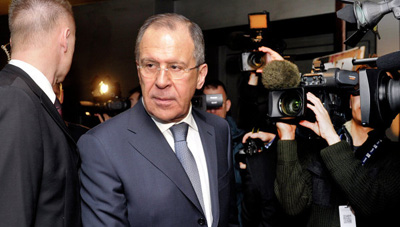
MUNICH, (ST)_ Russia believes the tragic situation in Syria could have been averted if all world powers had complied with the decisions of last June’s Geneva conference on Syria.
Speaking at the international security conference in Munich Saturday, Foreign Minister Sergei Lavrov also argued that the fallout of the ‘Arab Spring’ must be tackled realistically, responsibly and without the use of force.
History, Mr Lavrov said, is offering difficult choices, which cannot be made unilaterally, as if they were a zero-sum game. Russia, he pointed out, believes that only international collectivism can be of help.
He also warned instability mongers that their action will boomerang.
Russian Foreign Minister Sergei Lavrov added that the Syrian authorities keep chemical weapons under control and spoke against the removal of the Syrian Government.
“We have reliable information that so far the Syrian government controls the situation” with the chemical weapons, Lavrov said Saturday at the International Security Conference in Munich. “If the rebels seize those weapons, they will become a huge threat. But still, the situation doesn’t give any grounds for serious worries,” he added.
Lavrov reiterated that Russia’s stance against any foreign interference in the two-year civil war in Syria and a removal of its government. “The persistence of those who say that number one priority is to remove Assad is the only biggest reason for the continuing tragedy in Syria,” said Lavrov.
Russia sees nothing extraordinary in the fact that it has disagreements with the US, and it is willing to narrow them through equitable and respectful dialogue with Washington, Russian Foreign Minister Sergei Lavrov said.
“Our agenda is quite substantive and positive, but disagreements and differences still remain in relations between such major powers,” Lavrov said at the 49th Munich Security Conference on Saturday.
“We will take a principled approach to any issue in Russian-US relations that is supposed to be agreed upon, and we will be guided by principles of mutual respect, equitability, and mutual consideration of each other’s interests,” Lavrov said.
“We will certainly work together on issues on which we can work to benefit our countries and international security. We are already working,” he said.
The Organization for Security and Co-operation in Europe (OSCE) is experiencing a crisis because it is trying to impose its own standards on others, Russian Foreign Minister Sergei Lavrov said.
“We are talking about the future of the pan-European organization, the OSCE, disagreements in which are growing because of attempts to impose its own standards on others and turn it into a forum for polemics and confrontation, which can only worsen its systemic crisis,” Lavrov said at the 49th Munich Security Conference on Saturday.
“There is a need for consolidating projects that would cement the European space and help reach a consensus on fundamental security issues,” he said.
“I would hope that it is possible by 2015 to work out a truly common agenda reflecting not exchange of criticism but our common determination to focus on resolving common strategic issues through practically implementing the principle of indivisibility of security,” Lavrov said.
He said the chance for this still exists. Lavrov pointed out that the participants in a ministerial OSCE meeting in Dublin last December decided to launch the Helsinki +40 process.
Russian Foreign Minister Sergei Lavrov has urged the world community to reach agreement on shoring up democratic reforms in different countries without imposing external rules on these countries.
When addressing the ongoing international conference on security in Munich, he said that the Euro-Atlantic nations boast quite a few unifiers with regard to ultimate goals and efforts to settle various crises, according to the Voice of Russia correspondent.
All these nations want stability to rule supreme in the Near and Middle East, and North of Africa; they want the regional nations to advance towards democracy, as well as to have human rights guaranteed there.
Lavrov, besides, called for an agreement to abstain from external interference, especially an interference involving the use of force, without a UN Security Council mandate, as well as to abstain from slapping unilateral sanctions arbitrarily.
The Munich Conference on Security Policy that kicks off in Munich later today will focus on ways to strengthen the nuclear non-proliferation regime.
According to the Voice of Russia correspondents, the participants will take up Iran’s nuclear programme, the situation around North Korea’s preparations for an underground nuclear test, as well as the situation in Syria and Mali.
Russian Foreign Minister Sergei Lavrov will address the conference to set forth Moscow’s stance on international security problems, including the ways to settle the Middle East and North Africa crises.
Lavrov has been scheduled to meet the US Vice President Joseph Biden and the UN and Arab Leaguer special envoy to Syria, Lakhdar Brahimi.
Voice of Russia, TASS, Interfax, RIA Novosti