
Syrian Civil Defense launches A Project To Remove Rubble In Aleppo
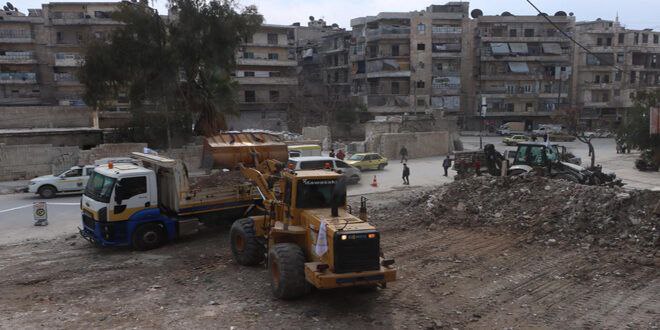
The Community Resilience Enhancement Program of the Syrian Civil Defense Foundation launched a project to remove rubble in a number of damaged neighborhoods in eastern Aleppo.
The program director at the foundation Ali Muhammad explained that the project is being implemented in cooperation with the Aleppo Governorate, the Technical Services Directorate, and the local council in the city.
The first phase includes three neighborhoods and extends over five months, starting from February and ending in June.
According to Muhammad, these neighborhoods were chosen based on the number of residents, the great destruction of the infrastructure, public facilities and government buildings in them, and in line with the current capabilities to obtain legal approvals. He pointed out that work is underway in the future on new projects to include other affected neighborhoods in Aleppo.
Mohammed explained that at this stage, the parts of the buildings that are at risk of collapse will be removed, due to their great risks to residents, especially during rain and wind storms.
He expected that about 40 thousand cubic meters of rubble would be removed during the project period, in accordance with the legal approvals for public and private property available, and the reports of the Public Safety Committee issued in determining the number of buildings that need to be demolished within the three mentioned neighborhoods. Mohammed stressed that the survey and removal of unexploded ordnance before work helps protect civilians from injury or death.
He considered that the project enhances the morale and mental health of the affected population, and also it has a positive psychological impact and makes them feel hopeful for the future so it can help alleviate feelings of displacement and loss. Mohammed said that after removing the rubble, the project is planned to recycle it to produce reconstruction materials, which is essential for economic recovery, creates jobs, stimulates local economies, and reduces environmental degradation and emissions according to special standards and specifications for mobile and fixed recycling plants.
An analysis within the 2022 Joint Damage Assessment Report for Syria, conducted by the World Bank Group in cooperation with the European Union, revealed the extent of damage in Syrian cities, with the city of Aleppo suffering the greatest amount of damage, reaching about 60 percent, while the extent of damage to its countryside reached about 50 percent, affecting the electricity, health, transportation and housing sectors.
Hanan Shamout