
Syria via the “Silk Road” heightens integration, dialogue and interaction
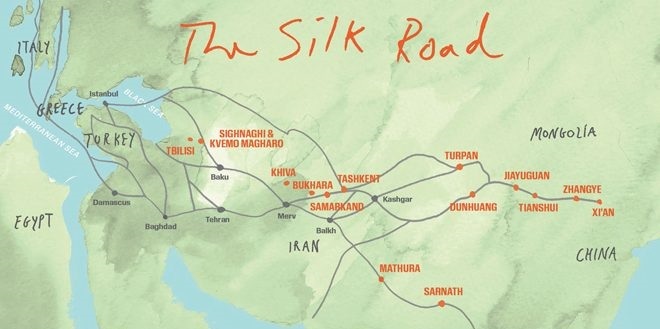
According to UNESCO, the Silk Roads formed a bridge between civilizations and contributed over thousands of years to the meeting of people and cultures coming from various regions of the world, which allowed the exchange of goods and the interaction between ideas and cultures and shaping the features of today’s world.
Since ancient times, Syria has formed a central point of contact between the civilizations of the world. The civilizations of Asia in general and the ancient civilization of West Asia in particular have provided the foundations for all modern civilizations.
Researcher Dr. Hammam Saad, Assistant Director of the General Directorate of Antiquities and Museums, said in a statement to SANA: “Syria is considered the center of ancient West Asian civilization. Our current world depended on the innovations that developed on Syrian soil.”
Saad continued: “Everyone knows the role that Syria has played since ancient times as a central point of contact between all the world’s civilizations. It is a land of openness, convergence, understanding, harmony, and exchange. Its location has formed the most important corridors for immigration and cultural interactions, as well as economic trade and military progress. On its land, cultures appeared. By virtue of its geographical location in the heart of the ancient world, knowledge about agriculture has spread from northern Syria to all parts of the Levant and Anatolia, and from there to the rest of the regions of the world, through cultural links and trade roads.
Saad pointed out that the Silk Roads linked the Chinese Empire in the East and the Roman Empire in the West, and between them there were hundreds of societies and many civilizations, and thus trade was the main liaison between civilizations. Palmyra was one of the most important stations on this road, and within this city one can see cultural, artistic and intellectual diversity, customs, traditions, and other matters related to all aspects of life, which represent an evidence of the process of mutual education among people.
Saad referred to the impact of the terrorist war against Syria and the unjust Western measures against it on all aspects of life, including cultural and intellectual life. He underlined the urgency of giving priority to cultural heritage to play a pivotal role in the process of mutual education for the younger generations, opening the way for field visits and direct contact, and mobilizing international efforts to provide support to countries whose heritage has been subjected to infringement and vandalism in previous years.”
In 1965, a cultural agreement was signed between Syria and China, and in 2016 the Ministry of Culture participated in the International Asian Youth Short Film Festival in Beijing with a group of films produced by the General Film Corporation. In 2019, the Syrian opera singer “Aoun Maarouf” was the only Arab voice to sing alongside four of the world’s elite opera singers, during the opening of the “Dialogue of Asian Civilizations” conference on one of the most important theaters in the Chinese capital, Beijing.
In 2021 a mobile exhibition of Syrian artifacts was held in several cities in China. These pieces are still on loan to China since 2019, and the exhibition has been extended until 2024.
An exhibition of Syrian antiquities entitled “Amazing Syria” was also opened on 8/4/2021 at the Nanshan Museum in the Chinese city of Shenzhen.
In 2023, with Syria’s participation, the (Asian Alliance for the Protection of Cultural Heritage) initiative was launched as part of the conference of the Council for the Protection of Asian Cultural Heritage, which was held in Xi’an, China.
Many Syrian female musicians had a feminine imprint in the Chinese capital, Beijing, through their participation in the Asian Civilizations Dialogue Conference, where the female musicians of the Oriental Takht, which was established in 2003 and directed by Dima Mawazini, sought to shed light on the cultural image of Syrian women. They presented a group of traditional Syrian musical pieces during an instrumental music listening session in the presence of musical groups from 48 countries.
The Silk Road was not just a road that crossed continents and countries, but rather it was a path that crossed cultures and affiliations, and an example of civilizational and cultural interaction and integration.
Dr. Yara Mualla, an expert in heritage and cultural diplomacy noted that it is true that the international name of the road is the Silk Road, but this road carried with it many heritage crafts and cultural industries that, with the succession of ages, formed an important part of the culture of all societies. The location of any city on this Road gave it great importance and cultural values. This is what gave Syria, with its cities located on the Silk Road, exceptional importance. It was the last focal point in Asia, and from there the roads were distributed in multiple directions branching off to Europe, Africa, and the Arabian Gulf.
In Syria, according to Mualla, the many Syrian antiquities are a witness to the extent of openness since ancient times to all civilizations and nationalities crossing its lands. Palmyra and Aleppo are centers of civilizational and cultural radiance along the road.
Mualla concluded: “Reactivating the Silk Road is a pioneering qualitative step, and we see promising future prospects in transferring and exchanging values and ideas and returning to the creative, interactive and open human nature. This would contribute to creating a sustainable world with its material and intangible cultural properties, and capable of providing a living and national economy based on culture and confronting challenges and disasters through effective dialogue, creative industries, and human relations built on acceptance and trust.”
Inas Abdulkareem