
“ Syria…The Mother” exhibition held by the wounded army personnel in Tartous
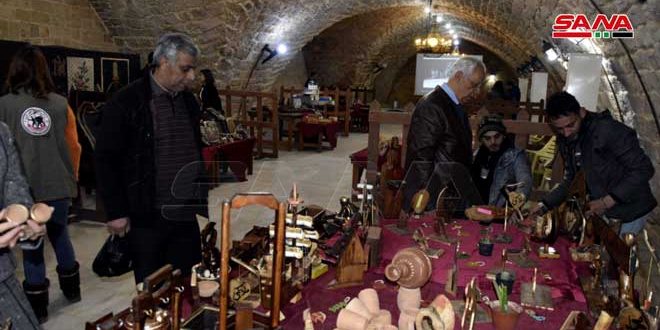
A number of wounded army personnel held an exhibition entitled “ Syria…The Mother” in the old city of Tartous province which included various handcrafts made of wood, bamboo and rural food products .
The three-day event was held by the Department of the Wounded in the governorate and Jareeh Al-Watan ( the wounded of the homeland) Project.
The exhibition is an opportunity for the wounded army personnel to showcase their professional and practical achievements within their small projects and to market and sell their products.
Tartous Governor Safwan Abu Sa’ada said in a statement to reporters , “Our wounded heroes have a strong will to be effective producers in various fields.”
For his part , Rabi’e Ibrahim, thevhead of the wounded department in Tartous governorate, pointed out that the exhibition is the first of its kind since the beginning of this year and includes the product of economic projects by the wounded personnel , stressing the exhibition’s main objective is to make every wounded a capable and strong one.
Ghinwa Abdul Rahim, director of Jareeh Al-Watan project team in Tartous, said, “The exhibition comes as a continuation of the steps that the project started by providing production grants to the wounded soldiers in order to reach the real production”, indicating to the project’s role in marketing these products.
“ the exhibition is of great importance for us as it represents a real starting point for promoting and marketing our work, which gives us a greater impetus for more” , the wounded Madyan Youssef, who founded the Syrian House project about four years ago said.
 The wounded Ali Hormuz presented wooden artifacts that he used to work with after it was just a hobby, making it the beginning of a new life for him and his own project, which formed a source of livelihood for him in addition to depending on recycling environmental and household waste materials.
 Regarding his project in beekeeping and honey production, the wounded Youssef Fares said that he started his project two years ago with the help of his wife and one of his relatives,” pointing out that the ten beehives he has are enough for him to produce honey and market it.
Rawaa Ghanam