
Syria, Russia hold dialogue on difficulties facing exportation
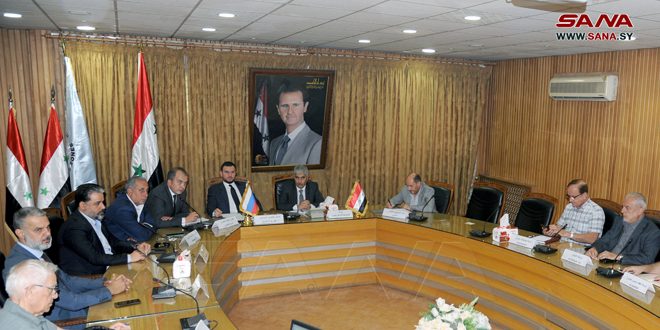
Damascus (ST): With the aim of identifying the difficulties and obstacles facing the export process, increasing the volume of trade exchange between Syria and the Russian Federation, and discussing possible solutions, a working meeting was held at the headquarters of the General Organization for Free Zones in Damascus, which included the director of the Authority for Support and Development of Local Production and Exports, Thaer Fayyad, the Russian trade representative George Asatrian and representatives of a number of food industrial companies wishing to export to Russia.
The deputy of the Russian Import and Export Authority, Artur Lier, and the director of the Russian E-Commerce Federation, Vitaly Gavrilov, participated in the meeting via video technology.
The participants in the meeting discussed the possibility of dealing in local currencies in the two countries, reducing customs duties, improving the shipping route, the necessity of providing infrastructure for trade exchange between the two countries, and the possibility of dealing with the principle of barter.
The participants agreed to prepare a paper summarizing the difficulties and problems facing Syrian industrial companies and a list of Syrian materials ready for export and submit it to the Russian Trade Representative for follow-up with the Russian guardian authorities, find appropriate solutions, organize visits for specialized companies to Russia, and hold direct meetings with the relevant authorities in Russia.
In a statement to news correspondent, Fayyad stressed the need to increase the volume of exports and trade exchange compared to the volume of Russian imports to Syria, and to overcome the difficulties that hinder the entry of Syrian products, indicating that the meeting will contribute to unifying efforts to find solutions, provide appropriate facilities, and create common conditions by both sides, in addition to strengthening Syrian participation in exhibitions held in Russia.
Fayyad pointed out that there will be successive meetings involving exporters of citrus, apples and other materials with the Russian side to discuss the reality of export to Russia.
For his part, Asatrian said: “The meeting was held at the initiative of the Russian Trade Representative in Syria and the Authority for Support and Development of Local Production and Exports, with the aim of finding solutions to develop Syrian exports, facilitating the access of Syrian products to Russian markets, and to identify the problems and obstacles faced by specialists in developing trade relations.”
For his part, Gavrilov pointed out the necessity of unifying the Syrian-Russian market in light of the availability of conditions and possibilities for Syrian products to enter Russia, expressing the Union’s readiness to assist and provide facilities for this, pointing out that payment consumption in the Russian electronic market amounted during the previous year to about 2.5 trillion rubles, and that the Union includes the largest distributors of wholesale materials and trading companies in Russia.
The deputy of the Russian Import and Export Authority indicated the possibility of making an exception for Syrian partners regarding the issue of customs and giving priority to areas of cooperation for the Syrian side, especially since there are economic partners in Russia interested in the Syrian product.
For his part, Vice President of the Chamber of Industry of Damascus and its Countryside, Talal Qalaji, confirmed that there is a desire from the food industrial sector in Syria to enter the Russian market, especially since Syria exports to about 120 countries around the world, pointing to the necessity of these products being present in the Russian market and overcoming the difficulties facing this, just like the rest of the world countries.
K.Q.