
Syria renews its demand for lifting the illegal Western coercive economic measures
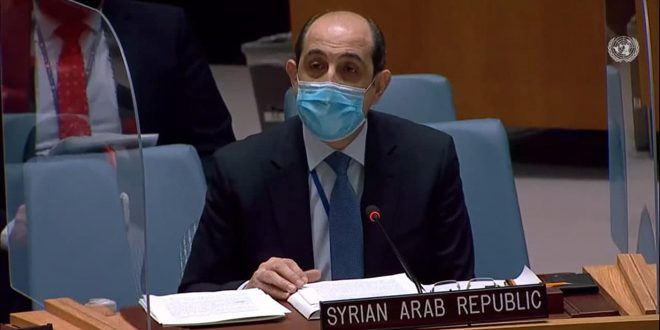
New York ,(ST) – Syria renewed its demand for the immediate and unconditional lifting of the illegal unilateral coercive economic measures imposed by the United States and the European Union, which caused the suffering of its people. It stressed that achieving stability requires eliminating terrorist organizations and ending the Turkish and American occupation.
Syria’s permanent representative to the United Nations, Ambassador Bassam Sabbagh, indicated during a Security Council session that the report of the Secretary-General of the United Nations on the humanitarian situation in Syria ignored the catastrophic effects of the coercive measures and the illegal siege imposed by the United States and the European Union, from which every Syrian suffers. He indicated that any objective matter related to the humanitarian situation in Syria leads to one conclusion that the main reason for it is the Turkish occupation, its practices and crimes, and its sponsorship of terrorist organizations and entities associated with it in the north and northwest of Syria.
Sabbagh said that the crimes of the Turkish regime against the Syrian people require urgent and firm deterrence from the Security Council.
“The Turkish regime obstructed the implementation of humanitarian convoys across the lines and the implementation of the “six-month plan,” he added.
Sabbagh also said that Syria, and its commitment to enhancing access from the inside to all parts of the country, agreed to the “six-month plan” presented by the United Nations, and responded positively and in record speed to all the requests it received.
Syria’s permanent representative to the United Nations indicated that the Secretary-General’s report confirmed that access to northeastern Syria was always possible for most of the supplies, and that 625 trucks were operated, in addition to what the report mentioned about Syria’s approval of a UNICEF and WHO convoy across the lines to Ras Al-Ain and Tal Abyad for vaccination against the Covid-19 virus. “Syria has also agreed to a humanitarian assessment mission for the United Nations in that area, which is the sixth approval it grants in the framework of implementing Resolution 2585” ,Sabbagh added.
Sabbagh stressed Syria’s rejection of the cross-border mechanism because it represents a flagrant violation of its sovereignty, independence, unity and territorial integrity.
He referred to the serious flaws that overshadowed the cross-border mechanism, foremost among which is the failure to ensure that aid reaches its beneficiaries and not to terrorist organizations. He pointed out that what the Secretary-General’s report confirmed about the existence risks related to the cross-border humanitarian operation proves the validity of Syria’s position on this mechanism, as the report refers to the fact that this operation it is managed remotely and that this part of the serviced area is under the control of a local authority that is widely believed to have close relations with a non-state armed group classified by the Security Council as a terrorist group, which confirms the possibility of these organizations controlling aid.
Sabbagh reiterated Syria’s commitment to a political solution based on a Syrian-Syrian national dialogue that achieves the aspirations of its people and ensures full commitment to its sovereignty, independence, unity and territorial integrity. He indicated that Syria looks forward to holding the seventh round of the Constitutional Discussion Committee and commends the positive contribution of the national delegation to its work, with an emphasis on the necessity of preventing interference in its work by outside parties or attempting to obstruct it.
In response to the delegates of the member states, Sabbagh said that establishing a comprehensive cessation of hostilities in Syria requires the elimination of terrorist organizations, primarily “ISIS” and “Al-Nusra Front” and the entities associated with them and an end to the Turkish and American occupation.
Raghda sawas