
Syria participates in the 31st Arab Music Conference in Cairo
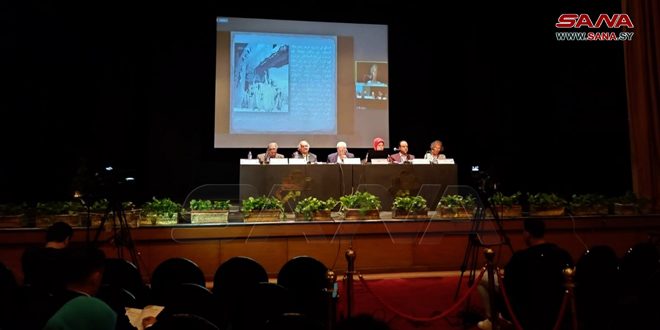
Yesterday Syria participated in the 31st Arab Music Festival and Conference, currently held in Cairo, entitled “the emergence and prosperity of the Arab Lyrical Theater.”
Researches submitted by Arab researchers focused on the emergence of this theater between prosperity and decline, the Arab operatic experiences of pioneers, and a review of the rich experiences of countries Arabic from the theater of Abu Khalil Al-Qabbani and the lyrical theater in Lebanon, the Levant and Egypt.
In her research titled “Lyrical Theater in the Levant and Egypt.. Qabbani and Rahabna”, the administrative officer at the Salhi Al-Wadi Institute for Music, Abeer Al-Jabi
Al-Jabi reviewed the historical background that established the emergence of the musical theater in Syria, and the popular stories that were presented in Damascus cafés by the storyteller , in addition to the performances of the traditional shadow theater “Karkoz and Iwaz”, and the accompanying performances of the Samahdance.
Al-Jabi stated that she discussed in her research the theater of Abu Khalil al-Qabbani from 1833-1903 in the Levant and Egypt, which is considered the pioneer of the Arab musical theatre.
She explained that since Al-Qabbani presented the play “Anas Al-Jalis in 1884”, he became more famous, and many theater pioneers studied under him, so that his activity and his band continued in Egypt for 17 years.
She indicated that 50 years after the departure of Al-Qabbani, the features of a new and very important experience in the lyrical theater began to crystallize in the Levant, whose banner was carried by the brothers Assi and Mansour Al-Rahbani.
She presented a summary of the journey of the Rahbani brothers and Fairuz in the field of musical theater.
Al-Jabi concluded that the influence of the Rahbani time on the Arab musical stage affected the important musical experiences at the levelsof word, melody, voice and performance, and produced great names in the world of Arab singing.
O. al-Mohammad