
Syria participates in high-level virtual dialogue on desertification, Land Degradation and Drought
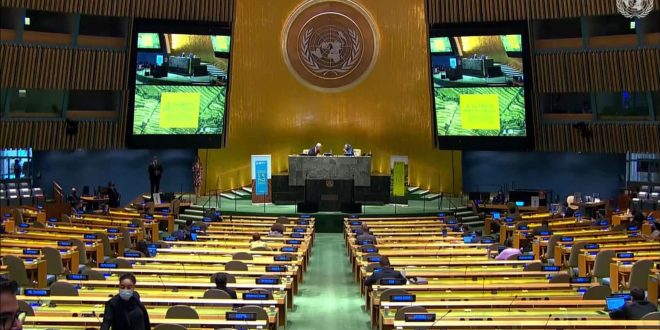
DAMASCUS, (ST)_With the participation of Syria, the United Nations General Assembly held on Monday a high-level virtual dialogue on desertification, land degradation and drought at the United Nations headquarters in New York to assess the progress made in this field and global efforts to revive and restore lands.
Representatives of governments, international institutions and organizations, who participated in the dialogue aimed to draw the attention of the international community on issues related to lands , encourage all member states to adopt and implement LDN (Land Degradation Neutrality )targets and national drought plans and encourage the private sector to participate and support the Land Degradation Neutrality Fund and exchange experiences, best practices, advanced technologies and innovative business models that Promote green, resilient and inclusive recovery strategies.
In a video-recorded speech broadcasted during the dialogue, Minister of Local Administration and Environment, Hussein Makhlouf, affirmed that the Syrian government is interested in the course of this dialogue and its results, hoping that environmental cooperation between countries, especially in our region would be enhanced.
Makhlouf said that forests, reserves and agricultural fields in Syria came under many terrorist attacks.This led to a significant deterioration in these systems and an increase in the pollution of the Syrian al- Badia soil, particularly in the areas of random refining of oil stolen by armed terrorist groups and their practices and those supporting them .This has negatively affected the implementation of plans and projects to combat desertification and rehabilitate degraded pastures at a time when the environmental situation in Syria needs international cooperation and support to confront these environmental challenges .
Globally, one fifth of earth’s land area – more than 2 billion hectares – is degraded, including more than half of all agricultural land. Unless we change how we manage soil, over 90% could become degraded by 2050. Land degradation negatively impacts one fifth of the planet’s land area and the livelihoods of 3.2 billion people, 40% of the global population. It accelerates climate change and biodiversity loss, and contributes to droughts, wildfires, involuntary migration and the emergence of zoonotic infectious diseases. But 1 billion hectares can be restored over the next 10 years to reverse course, and power COVID-19 recoveries and provide livelihoods at a time when hundreds of millions of jobs are at risk.
Basma Qaddour