
Syria is and Will Remain a Secular State
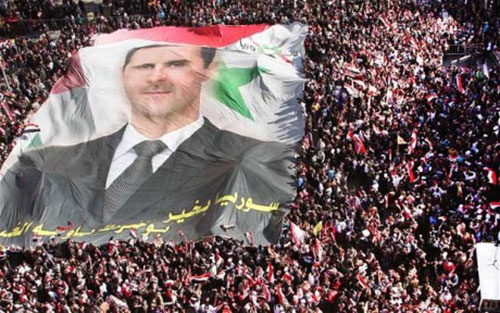
According to the Lebanese Al-Akhbar Daily, Russia occupies the strategy of Syrian President Bashar Al-Assad. He seems very reassured by the Russian role, but stresses that the Russians are not defending Syria as much as they are ultimately defending themselves. During a recent meeting with visitors at the presidential palace, including Al-Akhbar, Assad recalls a meeting he held in 2005 with President Vladimir Putin. At the time, the Syrian president told his host that he felt the Cold War still existed. Putin agreed, but tackled the question from a different angle: “True, it is a war,” he said, “but it is a cultural war between the East and the West.” This is a conviction that the Syrian president shares.
President Al-Assad, added the Daily, does not regret giving up chemical weapons. He maintains that their capacity for deterrence has expired for three reasons: First, Syria’s missile arsenal has made huge strides, so deterrence can now be established from the first moments of the war. This, he said, eliminated the need for chemical weapons, which can only be used as a last resort if the enemy deploys nuclear weapons. Second, Assad continues, huge progress has been made in the past two decades in countering the military effectiveness of chemical weapons, meaning, their effect is largely psychological.
Consequently, president Al-Assad says that Syria suspended production of chemical weapons in 1997, replacing them with conventional weapons, which he believes are the decisive element in the battlefield. Assad explains that he built the armament structure of his army based on missiles, saying, “It is enough to lay down fire on Israel’s airports to paralyze it,” since, as is known, Israel’s strength lies with its air force. Third, chemical weapons are obsolete because the war is now internal.
President Al-Assad says that Syria has no qualms attending, and that its only demand is clear and based on two principles: elections and ending support for terrorists. “Whenever we kill 1,000 terrorists, 2,000 more terrorists enter the country,” Assad says. The West’s problem, according to the Syrian president, is that the faction it supports is fragmented and has no control on the ground. The Free Syrian Army (FSA) is almost done for, he says. Its fighters have either abandoned it to join Islamic groups, or have joined the government and are now fighting in the ranks of the Syrian army. Nothing is left of the forces supported by the West and the Gulf except terrorists, who have no place in Geneva II.
“Not one Arab official has contacted us with a plan for mediation or for an Arab solution,” he says. The Arabs, he says, were always only an echo of their Western “masters,” if not worse. The problem, from Assad’s point of view, lies with the other side, specifically the West. Those that the West can bring to the conference, he says, have no control on the ground, and as for those who have control on the ground, the West has no influence over them. He recalls that Lakhdar Brahimi came to him one time, carrying an American assessment stating that there were 2,000 militant groups fighting in Syria. When the Syrian president asked him what his own estimate was, Brahimi said 1,200. So, Assad asks: Who can control all these groups and guarantee they would implement any political agreement?
“Not one Arab official has contacted us with a plan for mediation or for an Arab solution,” he says. The Arabs, he says, were always only an echo of their Western “masters,” if not worse.
Assad seems reassured by the progress of military operations. He says the war follows a hit-and-run pattern, where his army regains control of some territories while losing others, and so on. However, President Assad adds, if we consider the general course things have been taking, we would find that the Syrian army is clearly advancing. In the same vein, the Syrian president highlights two particular problems: Daraa and the Jordanian front on the one hand, and the north, on the other hand. In the first, Assad says that fighters and weapons continue to flow from Jordan, regardless of whether this was being staged by the Jordanian regime or Gulf countries. As for the second, specifically in Aleppo near the border with Turkey, Turkish support has kept the front hot. “But the Turks have a problem now, after al-Qaeda seized the crossing,” Assad says, adding that there are no intractable problems in the rest of the regions.
President Al-Assad denies categorically the reports circulated a few days ago, holding that Abbas Zaki, member of Fatah’s central committee, had brought him a message from the new emir of Qatar. Interestingly, beyond the reporter’s question about this issue, Assad did not mention Qatar again in the interview. Khaled Meshaal and his team in Doha figured more in our conversation with the Syrian president, in fact.
“Hamas has sided against Syria from day one. They have made their choice,” he adds.The conversation moves to Hamas when the president is asked about the reports regarding Meshaal’s visit to Tehran, and whether Damascus, specifically the presidential palace, would be his next stop. But Assad is keen on clarifying everything in this regard, ending all equivocation. First, Assad says that the Muslim Brotherhood, for 80 years, has been known for its opportunism and betrayal, but stresses that Damascus did not treat Hamas in the beginning as being part of the international Islamist organization. “The Europeans would come to us and ask what Hamas was doing here, and we would say that it was a resistance movement,” the Syrian president says, adding that only that capacity made Syria welcome and sponsor Hamas.
President Al-Assad says, “When the crisis began, [Hamas officials] claimed that they gave us advice. This is a lie. Who are they to give Syria advice? Then they said that we asked for their help, which is also not true. What business do they have in internal Syrian affairs?”
President Al-Assad is clearly still wounded by Hamas’ actions. But he keeps the door open to all possibilities if Syria’s interests require making certain rapprochements. In the end, he says, politics is about both principles and interests.
“[Iraq’s] stance has been very good from the beginning,” he says. Assad stresses that he’s not only talking about Baghdad, but also Iraqi Kurdistan. Though Iraqi Foreign Minister Hoshyar Zebari expressed some extreme positions, Assad says, Iraq’s stance remains “very good.”
Syria is and will remain a secular state because this is the only suitable formula for cohesion in the country, which enjoys religious, sectarian, and ethnic pluralism, Assad says.Meanwhile, Damascus has been closely monitoring the situation in Egypt. Assad asserts, “Egypt is the fortress of the Arabs,” saying that relations with Egypt are today better than they were, even under former President Hosni Mubarak.
In the meantime, hostility and estrangement with Saudi Arabia continues. At the end of the day, Assad remarks, Saudi Arabia is nothing more than “a state of tribes and individuals.” “Personal relations determine [policy], and when one person falls out with us, all of Saudi Arabia falls out with us,” he adds.“The Saudis have been hostile to Syria for the past 20 to 30 years to begin with. What changed was the relationship with their master. When their master’s relationship with us is good, they are good with us. When their masters fall out with us, they become hostile to us. There is always the personal factor in Saudi policies,” he says.
With respect to Turkey, according to Assad, the problem is confined to the person of Recep Tayyip Erdogan. The Turkish people, Assad maintains, are opposed to Erdogan’s policies. Even President Abdullah Gul has started to publicly express his opposition to the policies of his prime minister, Assad purports, saying that Gul thinks that if Erdogan wants to gamble with himself, he should at least not gamble his entire political party, the Justice and Development Party (AKP).
Under no circumstances will Syria follow the Lebanese or Iraqi model, President Al-Assad underlines. Syria is and will remain a secular state because this is the only suitable formula for cohesion in the country, which enjoys religious, sectarian, and ethnic pluralism, Assad says. He asserts there should be no politicization of religion in Syria because this would simply be a recipe for disintegration. Religion, he went on to say, has its spiritual and humanitarian functions, praising the vital role played by patriotic clerics in maintaining the unity of the Syrian fabric and combating takfiri ideas.
Dr. Mohammad Abdo Al-Ibrahim