
Syria, Czech Republic Discuss Economic, Trade Relations
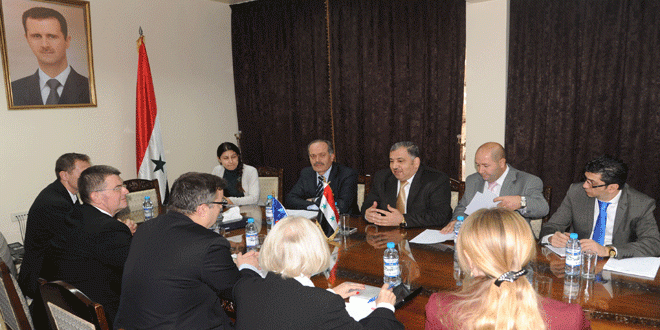
Damascus, (ST) – Industry Minister Kamal Eddin Tomah and members of the Damascus Chamber of Commerce met here yesterday with Czech Deputy Foreign Minister for Economic Affairs Martin Tlaba and his accompanying delegation. The two sides discussed ways to reactivate the economic, trade and industrial relations between the two countries.
The Minister of Industry emphasized the importance of the contribution of the Czech side in reconstruction projects in Syria, pointing out to a number of projects set up by the Czech Republic. Mr. Tomah highlighted the excellent relations in the pharmaceutical industry, where there is an intention to establish a plant for Serums and two lines for dry syrupin addition to other projects for the production of juice in the Syrian coast and electrical transformers.
Eng. Tomah pointed to the existence of projects in the medium term aims for the development of the textile industry and dairy laboratory in Damascus, Homs and two plants for the production of buses, tractors and the development of tires factory ready in terms of infrastructure.
The minister presented to the Czech delegation the possibility of preparing a memo of understanding including these projects, feasibility studies and methods of financing and the possibility of establishing a Czech line of credit to provide funding for these projects.
For his part, Mr. Tlaba pointed out that his country seeks to ensure the needs of Syrians, adding that the projects and ideas put forward by the Minister of Industry of concern to his government, stressing the continuation of industrial cooperation between the two countries in various fields.
He pointed out that his country is able to help in several areas, stressing the need to increase the industrial and commodity exchanges and the establishment of joint investments and provide the necessary funding.
During a visit by Mr. Tlaba to Damascus Chamber of Commerce, Chairman of the Board Ghassan al Qalla’ confirmed the importance of re-activating the economic, industrial and trade relations between the two countries and the signing of new agreements between them.
Mr. al Qalla’ pointed out that the “Syrian merchants are able to secure the needs of the local market, but the country needs during the coming period many materials, machinery and equipment to re-boot laboratories.’
The members of the Board of Directors of the Chamber referred to the negative effects of the unfair economic measures imposed by the Western countries on the economy and the citizens of Syria in various fields, calling for the lifting of these measures, especially relating to financial transactions and to develop trade exchange between the two countries and the opening of markets for Syrian products.
For his part, Mr. Tlaba pointed out that “his country is seeking to work to persuade EU countries to lift these measures, referring to the importance of contributing to the reconstruction and support for the Syrian state and alleviating the suffering of the Syrian people and to provide the necessary humanitarian assistance to enable them to stay in their country.
Sharif al Khatib