
Syria at UNHCR Forum: Takfiri Groups Deprive Millions of Syrians from Returning Home
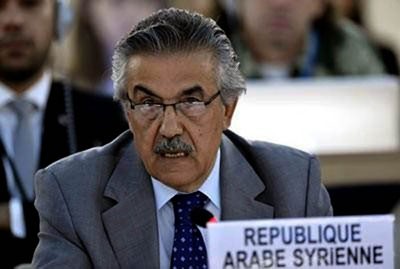
GENEVA, (ST) – Syria has stressed that the regionally and Arab-financed takfiri terrorism, which caused the bloodshed of innocent Syrians and the destruction of the state infrastructure, has led to the internal displacement of millions of citizens.
The remarks were made by Faisal al-Hamwi, Syria’s Permanent Representative at the United Nations in Geneva, during the United Nations Higher Commission for Refugees (UNHCR) Forum on “the Protection of Internally Displaced People in the World”.
Reading Syria’s statement in the forum, al-Hamwi said Syria never experienced the problem of internal displacement except when Israel displaced the Syrians from the occupied Syrian Golan after the Israeli aggression of 1967.
“Syria was a safe haven to all displaced people and refugees who came from different countries, where violence and oppression prevailed, without setting a single refugee camp to host them,” al-Hamwi said.
He clarified that from the beginning of the crisis in the country, the Syrian government has given top priority to the humanitarian issue and to providing assistance to displaced people.
The government has earmarked (SYP) 30bln for 2013 and (SYP) 50bln for 2014 to help the Reconstruction Committee and the Higher Relief Committee work to compensate the citizens for their losses and to guarantee the safe return of the displaced people to their houses after the army announces them secure.
Al-Hamwi stressed that the Syrian government also has cooperated with the UN humanitarian organizations working in Syria and provided them with all necessary facilitations to help humanitarian assistances reach the terrorism-affected families.
Syria’s statement also affirmed that the major challenge facing the government’s response to the needs of the affected and displaced people is embodied in “the destructive terrorist acts which randomly targeted the state infrastructure, in addition to the illegal unilateral sanctions imposed on the Syrian people by western countries, thereby affecting the level of services provided by the government.”
But those challenges didn’t weaken the Syrian government’s determination to provide services and assistance to the terrorism-hit people, according to al-Hamwi.
He described some international organizations’ refrain from doing their tasks and their attempts to politicize their operations as “a serious challenge” to the government’s humanitarian response efforts.
Al-Hamwi concluded by saying that “displacement, undoubtedly, has humanitarian dimensions, but its reasons are often political. Aid, however it is huge, won’t be able to solve the problem sustainably unless the causes of this problem are uprooted.
“This is applicable to the displaced people inside Syria because of the armed terrorist groups acts,” he said, stressing that ending the suffering of the displaced people necessitates the halting of foreign financing and support provided by regional countries to the takfiri groups which continue to deprive millions of Syrians from returning to their houses and benefiting from the services provided by the government and the humanitarian bodies.
H. Mustafa