
Stealing Syria’s Water
Part II
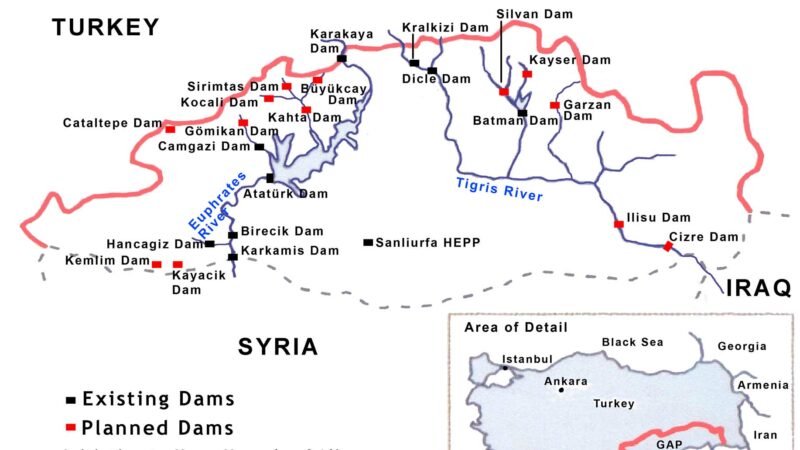
The Gap project (southeastern Anatolia), includes the construction of 22 dams on the Euphrates and Tigris rivers, of which 17 dams have been completed so far ….. Despite all the gains that the project brings to the Turkish side, when the dams are fully built, the countries downstream of these two rivers will lose 70 percent of the natural flow of the Euphrates River and 50 percent of the natural flow of the Tigris River.
Britain and Switzerland were at the top of the countries enthusiastic about the Gap project and at some point contributed to the financing of the project, before they stopped due to the pressure exerted by international environmental non-governmental organizations supported by Syria, and given the concerns about the conflicts that may arise from this project, especially the aspect related to sharing water with Syria and Iraq. These same factors led the World Bank to refrain from granting Turkey loans to move forward with the project.
The main point on which Turkey relies on in its negotiations, is the “privatization” of the Tigris and Euphrates rivers, according to a unilateral interpretation of the rules of fair and reasonable use of water, and in a behavior that does not respect the borders of the countries bordering it and the needs of its residents.
The first meetings that the Turks held with Syria and Iraq regarding the two countries’ shares of the Euphrates and Tigris waters began in 1962, and took place with each country separately, and remained without results until 1980, when Turkey signed a bilateral agreement with Iraq without including Syria. This agreement was meaningless, and no results were filtered from it, especially with regard to the Euphrates River, as it did not include the first downstream countries.
From the start of negotiations in 1962 onwards, different positions gradually crystallized regarding the Gap project and the sharing of the Euphrates waters between Turkey and the downstream countries. From May 1982 to October 1992, Syria and Iraq organized 16 discussion sessions with Turkey, either bilaterally or tri -laterally. The main objective of these discussions, which were described as “technical”, was to exchange hydraulic data in a way that would enhance cooperation between the three countries. The negotiations witnessed two peaks of escalation, in 1974 and 1990. The first peak was in January 1974, and it was an Iraqi dispute with both Syria and Turkey, as this coincided with the filling of the Turkish and Syrian dams. In 1990, Syria, and Iraq to a lesser extent as a result of their preoccupation with the second Gulf War, confronted Turkey with filling a lake Giant Ataturk Dam.
Previously, in 1987, Turkey “agreed” to sign a bilateral protocol with Syria (the 1987 Protocol on Issues Related to Economic Cooperation between the Syrian Arab Republic and the Republic of Turkey), guaranteeing a minimum flow of the Euphrates River at the border of 500 cubic meters per second, which is the equivalent of 56.2 percent of the natural flow at the border, “during the period of filling the Ataturk Reservoir and pending the conclusion of a tripartite agreement.” This agreement came in the form of a “Turkish consent,” because Turkey considered it stemming from a Turkish “understanding” of the needs of the downstream countries, and never in response to any Syrian or Iraqi right to the Euphrates River. In fact, the protocol was not signed as a result of the Turkish understanding. Rather, the internal security context and the conflict with the Kurdistan Workers Party (PKK) were at the heart of the reasons that forced Turkey to sign the protocol.
To confirm this protocol signed between Syria and Turkey, a bilateral agreement was signed between Syria and Iraq in 1990 (joint minutes between Syria and Iraq, April 17, 1989), in which each country’s share of the Euphrates River water that Turkey allowed to flow into Syrian territory was determined. The percentages were set at 42 percent for Syria and 58 percent for Iraq, depending on the length of the river in both countries and the size of its basin. However such was Turkey’s arrogance that no tripartite agreement was signed on the sharing of the river’s water between the upstream and downstream countries and this is something that Turkey constantly evades.
Reem Haddad
Editor – in – Chief