
Stealing Syria’s Water
Part I
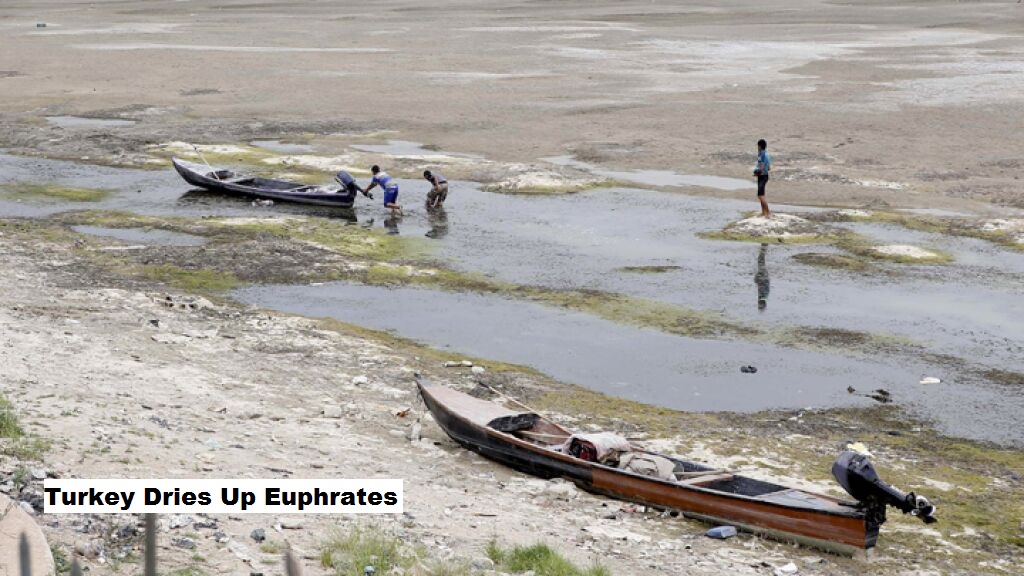
Pictures show that there is hardly any water in the Euphrates River-the branch passing through Syria and Iraq, for the water has been taken hostage by Turkey. In legal treaties and protocols signed between Syria and Turkey the agreed flow of water to Syria is 500 cubic meters per second .Today it doesn’t exceed 200 cubic meters per second.
This decline has caused severe damage to farmers in Syria, and consequently to the already deteriorating food security of the country’s population. The agricultural areas dependent on the Euphrates River in eastern Syria are the country’s basket of strategic crops, primarily wheat. The decline also led to an increase in the rates of salinity and pollution in the river water, and deprived many cities and villages of the few hours provided by the dams of electricity, after the nominal storage levels in the lakes of the Euphrates and Tishreen dams decreased, and they reached – almost – what is known as the “dead level”. This means stopping the work of the two dams completely, in order to essentially conserve drinking water, and allocate some quantities to irrigate the lands.
The logical conclusion to the drop in water levels in Syria is that Iraq’s share of the Euphrates water would also be reduced, which in turn has made the water situation in Iraq disastrous. It is known that the waters of the Euphrates are fed by rain and melting snow during the spring period, and the water quantities rise from November to April, and then decrease from May to October. However, the current decline in river rates is not natural, nor is it a result of seasonal variation and water evaporation due to high temperatures, but it is evidence that the quantities of water have been decreasing over the past months, as monitoring of the decline in water rates in Syria began since January 2021.
More than 70 percent of Syria’s water originates outside its political borders
The Euphrates River originates in southeastern Turkey, with a length of 2,781 kilometers and a basin area of 444,000 square kilometers, of which 28 percent is located in Turkey, 17.1 percent in Syria, and 39.9 percent in Iraq. The waters of this river constitute 80-85 percent of Syria’s water resources, thus being the country’s water nerve, and the most important provider of drinking water and irrigation, especially since the larger areas of Syria have little rainfall and are poor in potable groundwater (wells). Moreover, agricultural revenues that constitute about 25 percent of the country’s GDP depend completely on water. The irrigated lands are mainly concentrated in the Euphrates basin.
Naturally these percentages do not take into account the large waves of refugees, the great damage to the country’s water infrastructure due to terrorist organizations, or the excessive use of non-renewable water resources and their pollution as a result of hostilities, and the absence of supervisory authorities in areas where the Syrian government is not present.There is no doubt that the water security of Syria is one of the concerns that should be paid close attention to,.The double importance of the Euphrates Basin in the future comes from the fact that water resources will be depleted in five other major water basins in the country: Barada, Al-Awj, Al-Assi, Al-Sahob, Tigris, Al-Khabour, and Yarmouk.
Syria has incessantly asked that the water issue be addressed and that Turkey comply with the water protocol it signed .Up till today Turkey remains the major thief of the water in Syria and hence encouraging the spread of disease and lack of water related illnesses.
Reem Haddad
Editor-in-Chief