
“Sourakioun”… A Book Containing Iraqi Poems In love with Syria
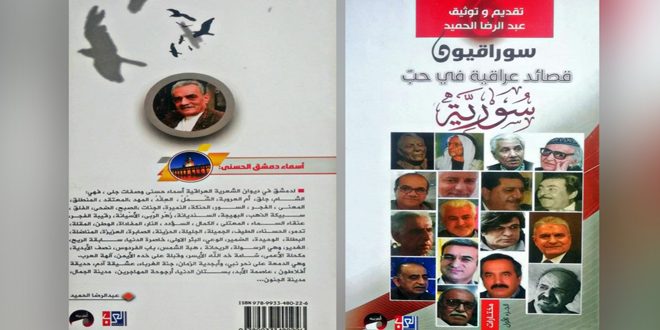
The Iraqi poet Abd al-Rida al-Hameed documented in the book “Sourakioun” the poems of a number of Iraqi poets who loved Damascus and Syria and who believed in its history, authenticity and nationalism .In this book, each poet presents in a different manner and with talents that managed the reality of the historical relationship between Syria and Iraq.
In Al-Hameed’s book, there is a beautiful description of Damascus, its authenticity,its deep-rooted history and its association with Babylon and the impact that poets and old wise personalities had on both Syria and Iraq, such as Al-Numan bin Al-Munthir and Qis Ben-Saada Al-Eyadi, in addition to Syria’s great role in confronting the Iraq war and standing alongside Baghdad.
The book’s poetry texts recount many of the conspiracies to which Syria has been subjected to, its insistence on upholding its belonging and Arabism, confronting Zionist conspiracies, and its people, men and women’s insistence on protecting the homeland and Arabism and not submitting to those who want to jeopardize it.
In some of the book’s texts, Iraqi poets are determined to show up all those who betrayed their homeland and who stood against Syria in its recent confrontation with terrorists in a systematic documentation of the events in an emotional poetic style that adhered to the authenticity of poetry, language, rhyme and narration.
The book highlighted Syria’s stance by receiving all Iraqis, which was clearly reflected in the poetry of a number of poets such as Abdul Razzaq Abdul Wahed, Mohammed Mahdi al-Jawahiri, Abdulwahhab al-Bayati, Sharif al-Din al-Hali, Shukr al-Salehi, Issa al-Abadi, Fayez Al-Haddad, Wajeeh Abbas, Fadel Farman, Jalil Khazal and Rasim Al-Marwati, Waleed Hussein, Muzaffar Al-Nawab, and others.
The 264-page book, which is issued by Dar al-Arab in Syria and the Arab Newspaper House in Baghdad under the supervision of the Arab Writers’ Union, has great historical value for the relationship between Syria and Iraq, and describes the great love for Damascus and Syria in the Iraqi poetry.
Amal Farhat