
Scientists describe how solar system could have formed in bubble around giant star
Despite the many impressive discoveries humans have made about the universe, scientists are still unsure about the birth story of our solar system, according to Science Daily.
Scientists have laid out a comprehensive theory for how our solar system could have formed in the wind-blown bubbles around a giant, long-dead star, the study addresses a nagging cosmic mystery about the abundance of two elements in our solar system compared to the rest of the galaxy.
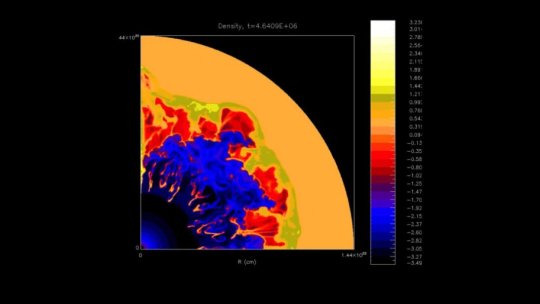
The general prevailing theory is that our solar system formed billions of years ago near a supernova. But the new scenario instead begins with a giant type of star called a Wolf-Rayet star, which is more than 40 to 50 times the size of our own sun. They burn the hottest of all stars, producing tons of elements which are flung off the surface in an intense stellar wind. As the Wolf-Rayet star sheds its mass, the stellar wind plows through the material that was around it, forming a bubble structure with a dense shell.
“The shell of such a bubble is a good place to produce stars,” because dust and gas become trapped inside where they can condense into stars, said coauthor Nicolas Dauphas, a professor. The authors estimate that 1 percent to 16 percent of all sun-like stars could be formed in such stellar nurseries.
This setup differs from the supernova hypothesis in order to make sense of two isotopes that occur in strange proportions in the early solar system, compared to the rest of the galaxy. Meteorites left over from the early solar system tell us there was a lot of aluminium-26. In addition, studies, including a 2015 one by Dauphas and a former student, increasingly suggest we had less of the isotope iron-60.
This brings scientists up short, because supernovae produce both isotopes. “It begs the question of why one was injected into the solar system and the other was not,” said coauthor Vikram Dwarkadas, a research associate professor in Astronomy and Astrophysics.
This brought them to Wolf-Rayet stars, which release lots of aluminium-26, but no iron-60.
“The idea is that aluminum-26 flung from the Wolf-Rayet star is carried outwards on grains of dust formed around the star. These grains have enough momentum to punch through one side of the shell, where they are mostly destroyed — trapping the aluminum inside the shell,” Dwarkadas said. Eventually, part of the shell collapses inward due to gravity, forming our solar system.
As for the fate of the giant Wolf-Rayet star that sheltered us: Its life ended long ago, likely in a supernova explosion or a direct collapse to a black hole. A direct collapse to a black hole would produce little iron-60; if it was a supernova, the iron-60 created in the explosion may not have penetrated the bubble walls, or was distributed unequally.
N.H.Kh