
Sabbagh urges holding the countries that aided terrorist groups in Syria obtain and use chemical weapons accountable
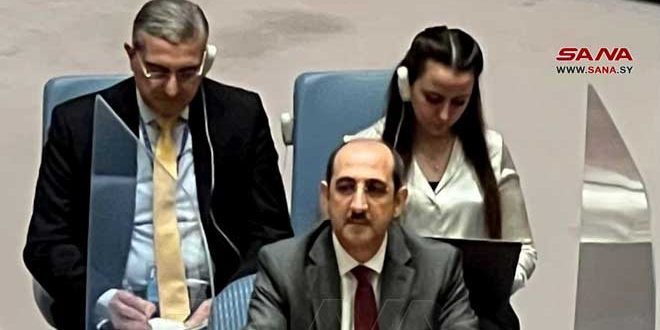
The countries that supported terrorist organizations in Syria and helped them possess and use chemical weapons should be held accountable, Syria’s Permanent Representative to the United Nations Bassam Sabbagh said during a Security Council session on Friday marking the 25th Anniversary of putting the Chemical Weapons Convention (CWC) into effect.
Sabbagh reiterated that the universality of the CWC will not be achieved without forcing Israel to join the convention and as long as the western countries continue to misuse its rules and politicize its goals.
He clarified that the some parties continue to provide immunity to Israel and its arsenal of chemical weapons and other weapons of mass destruction which pose serious a threat to international and regional peace and security.
Sabbagh said that though the CWC has made major achievements, including helping the Syrian government eliminate its stockpile of chemical weapons, yet its implementation has faced massive challenges. He added that these challenges emerged because the United States has procrastinated in implementing its obligations towards destroying its stockpile of chemical weapons within the set time and because some western countries have misused the rules of this convention and politicized its goals with the aim of using it as a tool to target and blackmail the governments of the countries that refuse to subjugate to their dictates.
The Syrian diplomat affirmed that Syria has fully cooperated with the Organization for the Prohibition of chemical Weapons (OPCW) and implemented all its obligations pursuant to the CWC, clarifying that Syria has provided detailed information about the names and kinds of chemical agents, ammunition, production and storage facilities and then destroyed its chemical stockpile in a record time.
He went on to say that Syria frequently provided the Security Council and the OPCW Technical Secretariat with information about the continuous attempts of the terrorists of ISIS, Jabhat Al-Nusra and other armed groups to get chemical weapons and toxic chemical substances and use them against the Syrians through carrying out false flag operations with chemical weapons and then accuse the Syrian Arab army of using these weapons against civilians.
According to Sabbagh, Syria has recently provided information about Jabhat Al-Nusra (Hay’at Tahrir Al-Sham) in Idlib possessing chemical substances as well as modified rockets equipped with toxic substance in coordination with the Turkish regime forces in preparation for staging a chemical attack.
He stressed that possessing chemical weapons and toxic chemical substances by these terrorist groups is a very dangerous issue, pointing out that the full implementation of the rules of the CWC by its member countries is absolutely necessary to prevent these weapons from ending up in the hands of the terrorist organizations.
Sabbagh indicated that Syria has provided the fact-finding mission of the OPCW with all facilitations to do its work, but this mission didn’t abide by the terms of reference agreed on, didn’t abide by the rules of the CWC and didn’t adopt the required professionalism and independence in its work. He clarified that the mission confined its work to conducting remote investigations and it received samples that it didn’t directly collect, depended on images and videos derived from open sources and listened to testimonies by people brought from the incubating environment of terrorist groups.
Sabbagh expressed Syria’s concern over the procrastination of the fact-finding mission in preparing its reports on the chemical incidents into which Syria has requested investigation to uncover the use of chemical weapons by the terrorist groups in the country but the mission did nothing about it.
He concluded his statement by saying that commemorating the 25th anniversary of putting the CWC into effect is an opportunity to renew the call for not politicizing the OPCW and for maintaining the technical nature of its work and address the wrong practices of some of its teams.
Hamda Mustafa