
Sabbagh underlines urgency to lift siege imposed by United States and European Union on Syrian people
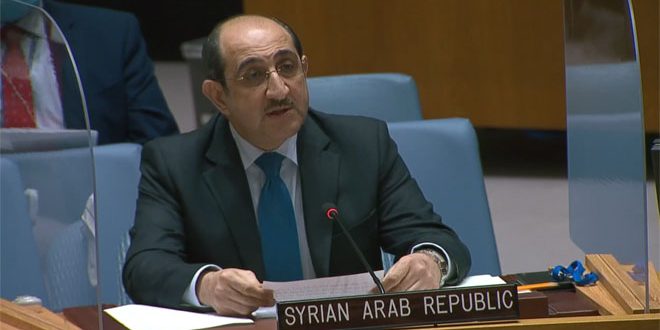
Syria’s permanent representative to the United Nations, Bassam Sabbagh, reiterated the need to immediately lift the illegal siege imposed by the United States and the European Union on the Syrian people, which represents collective punishment and economic terrorism that greatly harms the state’s efforts in the humanitarian and development fields and the ability of Syrians to get their basic needs.
During a session of the UN Security Council on Wednesday, Sabbagh noted that during the period following the council’s recent discussion of the humanitarian situation, Syria witnessed a number of meetings and visits of UN representatives. These visits aimed at continuing Syria’s constructive cooperation with those UN agencies and other partners in order to improve the humanitarian situation and provide services and support for those in need throughout the country. Sabbagh expressed hope that the visit of the Under-Secretary-General for Humanitarian Affairs Martin Griffiths to Syria will contribute to correcting the course of the relationship with the United Nations Office for the Coordination of Humanitarian Affairs “OCHA” and strengthening cooperation with it in accordance with the principles of humanitarian action established by the General Assembly and professional and objective standards away from politicization and the dictates of some Western governments’ loyalists.
Sabbagh went on to say that after a long obstruction by the Turkish occupation forces and its allies of terrorist organizations, the convoy of the World Food Program, which was approved by the Syrian government several months ago, was able to reach Sarmada in northwestern Syria via the lines from Aleppo in coordination with the Syrian Arab Red Crescent. The Syrian concerned parties have taken all necessary measures to provide a safe passage for this convoy and to ensure the security and safety of the United Nations and national teams responsible for it.
Sabbagh expressed Syria’s condemnation of the Turkish occupation forces and its terrorist allies obstructing the delivery of the aid convoy to Al-Atareb region in northwestern Syria from the inside. At the same time, the Syrian government in close coordination with the United Nations agencies and the Syrian Arab Red Crescent, approved sending an inter-agency aid convoy to Daraa governorate. The World Food Program resumed implementing its monthly programs and distributing food hampers there after ensuring the security and safety of the convoy and humanitarian teams, and the reach of these aids to its beneficiaries.
Sabbagh referred to the Secretary-General’s recent report, which confirmed that during the period between January and July, 1588 trucks crossed the Syrian Jazeera to provide humanitarian aid; an average of 227 trucks per month, compared to 199 trucks during the same period in 2020. The World Health Organization delivered three shipments through two air bridges and one land convoy. The report also reiterated the provision of aid to millions of Syrians in all governorates, including food aid to about four million and eight hundred thousand people, stressing that all these achievements would not have been possible without the cooperation, facilities and support provided by the Syrian government.
Sabbagh highlighted Syria’s commitment to work to deliver aid from inside the country and its adherence to its position calling for an end to the politicized “cross-border mechanism” that violates its sovereignty and territorial integrity, and exposing the hostile role played by the Gaziantep office and the fabricated reports it presents.
Sabbagh pointed out that the coercive measures imposed by some Western countries on Syria led to a significant shortage of food, medicine, medical supplies, fuel and electric power. This issue requires urgent dealing, especially with the spread of the Corona epidemic which poses an additional threat to the health of Syrians. Britain, which does not stop claiming humanitarian concern, is obstructing efforts aimed at strengthening the capacity of the Syrian health sector to tackle the epidemic and preventing the competent laboratories from obtaining the equipment necessary to carry out the relevant tests.
Sabbagh stressed that improving the humanitarian situation requires full respect for Syria’s sovereignty, independence, territorial integrity- a principle confirmed by all relevant Security Council resolutions. He also underlined the necessity of ending the illegal foreign military presence on Syrian territory and stopping the crimes and practices of the US and Turkish occupation forces based on prolonging the crisis and supporting terrorism. Sabbagh highlighted the need to compel the Turkish regime to stop using water as a weapon of war against the Syrians and to use it for political purposes in order to ensure the continuity of the work of the Allouk water station and the flow of the Euphrates River according to the rates agreed upon between the two countries.
Sabbagh stressed the need to immediately and unconditionally lift the illegal and immoral blockade imposed by the United States and the European Union on the Syrian people, which represents collective punishment and economic terrorism that seriously harms the Syrian government’s humanitarian and development efforts and the ability of Syrians to obtain their basic needs.
Sabbagh pointed to the importance of enabling the United Nations to complete the agreement with the Syrian government to ensure support for efforts to achieve sustainable development. He called for the stop of those governments’ destructive approach and investment in terrorism.
Sabbagh reiterated Syria’s willingness to embark on a new phase of cooperation and will continue to provide facilities for the work of the United Nations and its competent agencies in light of its full adherence to Syria’s sovereignty, independence, territorial integrity and safety. Syria is looking forward to real partnerships that support its efforts to restore security and stability, provide aid to those in need, enhance development work, and reconstruct the necessary infrastructure and facilities to ensure the return of the displaced to their homes.
Inas Abdulkareem