
Sabbagh: Improving the humanitarian situation in Syria requires lifting the coercive measures imposed on it
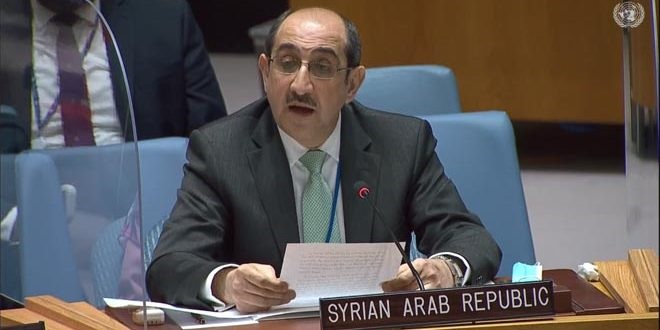
New York, (ST) – Syria’s permanent representative to the United Nations, Bassam Sabbagh reiterated that,improving the humanitarian situation in Syria requires the immediate lifting of the unilateral coercive measures imposed on it, There must be an end to the looting of Syria’s national resources and wealth, and an end to the politicization of humanitarian action and linking it to terms of loyalties and dictates that contradict its principles.
During a Security Council session today on the situation in Syria, Sabbagh stressed the need to support the efforts of state institutions to alleviate suffering and provide support and services to Syrians by supporting development goals and rehabilitating damaged structures to facilitate the safe return of displaced persons and refugees. He stressed on supporting the efforts of these state institutions in combating terrorism and eliminating the threat it poses, the terrorist organization “ISIS” and “Al-Nusra Front” and the entities associated with them. Sabbagh also pointed out that, there is the necessity of ending the illegal foreign military presence on Syrian territories.
Sabbagh said that, the statements of some countries during this session show that they are still exploiting the Security Council as a platform to politicize humanitarian work in Syria and practice political hypocrisy and promote a misleading approach that diverts discussions from the main topic in order to serve its goal of prolonging the humanitarian crisis in Syria. He indicated that, Western countries insist once again on the claim that extending the so-called “mechanism for the delivery of aid across borders” will improve the humanitarian situation in Syria. This is a deficient view that expresses extreme selectivity and discrimination against Syrians, and obscures the facts and fundamental reasons for the decline of the humanitarian situation in Syria, foremost among which are the crimes of occupation, aggression and terrorism, including economic terrorism which is represented by unilateral coercive measures.
Sabbagh pointed to the fundamental flaws in the so- called “mechanism for the delivery of aid across borders” related to the lack of coordination with the Syrian government, because most of it flows into the hands of the terrorist organizations controlling Bab Al-Hawa crossing. He reiterated wondering on the continuation of this mechanism’s work, allowing the use of a crossing controlled by the “Al-Nusra Front” organization, which is listed on the Security Council’s list of terrorist entities, to bring aid across the border.
Syria’s permanent representative to the United Nations stressed that what the representatives of Western countries claim to be of humanitarian concern for the Syrian people contradicts the procedures of their countries by imposing destructive unilateral coercive measures that cause human suffering as a result of severe shortages in food, medicine, medical equipment, water and basic services, in addition to their negative impact on the operations of delivery of humanitarian aid.
Sabbagh pointed out that, these countries’ alleged keenness contradicts their policies aimed at covering up the crimes of the terrorist organizations and separatist militias that sponsor them, and their silence on the practices of the American occupation forces in northeastern Syria and in the Al-Tanf region, and their looting of the Syrian people’s capabilities, oil wealth, agricultural crops and cultural property.
Sabbagh went on to say that, the Turkish regime continues to violate the bilateral agreements concluded with Syria and the relevant international treaties by reducing the flow rate of the Euphrates River, which has seriously damaged the water reserves in Syria and the supply of potable water and irrigation water for agriculture, in addition to stopping the hydroelectric generation groups in Tishreen and Tabqa dams.
Sabbagh pointed out that the crimes of the Turkish occupation and its terrorist organizations have not stopped there, but rather they threaten the future of Syrian students by depriving them of continuing their education.
Sabbagh said that the claim of the authors of the report of the General Secretariat of UN that, that extending the mechanism of introducing aid across the border will contribute to the provision of vaccines against Corona is incorrect, as those who wrote the report acknowledge that the vaccines that were provided to Syrians in the areas under the control of the Syrian state have covered only half a percent to date. The authors of the report overlooked the fact that the separatist militias, agents of the American occupation forces in northeastern Syria, recently obstructed the vaccination campaign against Corona being carried out by the teams of the Ministry of Health in the areas of Deir Ezzor Governorate and prevented the mobile vaccination teams from entering the camps in Al-Hasakah Governorate and promoted false rumors about the safety of vaccines.
Sabbagh indicated that the main and influential part of the United Nations humanitarian and relief work in Syria was and is still being carried out from inside Syrian territories in coordination and cooperation between the Syrian government and humanitarian partners. He pointed out that, this mechanism is the best and most consistent with international law and the simplest as it means respecting the principle of Syria’s sovereignty, unity and territorial integrity which is confirmed by all relevant United Nations resolutions.
Sabbagh affirmed Syria’s commitment to make every effort to improve the humanitarian situation of its citizens and alleviate their suffering caused by wrong policies and aggressive practices of some countries. He pointed out that it will continue to provide the necessary facilities for the work of the United Nations and other partners in humanitarian work to ensure that aid reaches at the appropriate time and without prejudice , which depicts Syria’s keenness on the security and safety of convoys and humanitarian workers.
Raghda Sawas