
Russian Memorandum on De-escalation Zones in Syria Signed
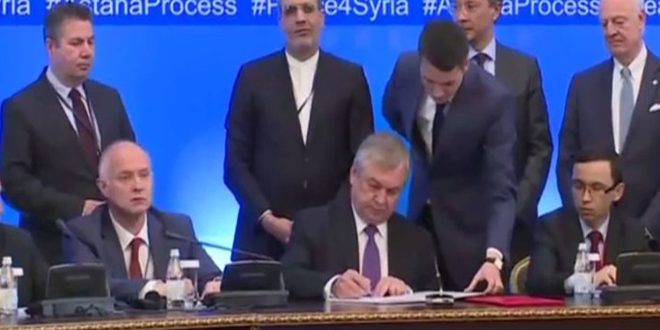
ASTANA, (ST)- The countries acting as guarantors of the cessation of hostilities in Syria, ( Russia, Turkey and Iran) have signed the Russian memorandum on setting up de-escalation zones in Syria.
The document, which was signed on Thursday during the plenary session of Astana 4 meeting on the crisis in Syria, called for establishing de-escalation zones in the Syrian province of Idleb as well as in north of Homs, in eastern Ghouta of Damascus and in Syria’s southern area. The zones are to be set up by the guarantor countries and concerned parties with the purpose of putting an immediate end to fight activities, improve the humanitarian situation and prepare suitable environment for reaching political settlement to the crisis in Syria.
Head of the Syrian Arab Republic’s delegation to Astana 4 meeting Bashar al-Jaafari said that Astana 4 meeting was a turning point in terms of achievements. He thanked Kazakhstan, Russia and Iran for their efforts to reach this important achievement, which will help open the way for political solution.
In a press conference following the plenary session of the meeting , Al-Jaafari added “we hope that our Russian and Iranian friends will discuss the details of the Russian memorandum with Damascus as soon as possible”.
Yesterday, a source at the Syrian Ministry of Foreign Affaris and Expatriates said that “Syria supports the Russian initiative on establishing de-escalation zones in the country and affirms its commitment to the agreement on the cessation of hostilities signed on December 30, 2016, including the non shelling of these zones.
The ministry source said that Damascus stance was made starting from the Syrian Arab Republic’s commitment to protecting the life of the Syrian people and stopping bloodshed in the country. It came to stress Syria’s agreement on everything that would help restore normal life to the Syrians, including reactivating the Syrian economy and improving the living conditions of the Syrian citizens who suffered a lot because of the terrorist war imposed on their homeland.
The source added that the Syrian Arab Republic asserts that the Syrian Arab army and its allies and supportive forces will press ahead with their war on terrorism and their fight against Daesh, Jabhat al-Nusra and their affiliated armed groups wherever they exist in the country.
During the plenary session, Kazakhstan’s Foreign Minister Kairat Abdrakhmanov, said that the delegations of the countries acting as guarantors of Astana process, reaffirmed their commitment to the sovereignty, independence and territorial integrity of the Syrian Arab Republic. They asserted that there is no military solution to the crisis in Syria, but a political process based on the implementation of Security Council resolutions, particularly Resolution No. 2254 in full, Abdrakhmanov added.
The Kazakh minister went on to say that the guarantor countries have adopted a document of understanding on establishing de-escalation zones in Syria aiming to stop the ongoing violence, to improve the humanitarian situation, to create suitable circumstances for political solution to the crisis and to effectively fight terrorism.
Content of the Russian document on creating de-escalation areas in Syria
According to the Syrian news Agency SANA, Russian sources revealed on Thursday the content of the document of proposals put forth by Moscow on the establishment of de-escalation zones in Syria.
The document affirmed that the Russia, Iran and Turkey are guarantors to ensure that the cessation of hostilities regime is respected in the Syrian Arab Republic and will be referred to as “the guarantors”.
 The document called for the creating of reduction-of-tension zones in Idleb province, to north of Homs and in Damascus’s Eastern Ghouta by the guarantors, and in southern Syria by the guarantors and other concerned parties, with the aim of putting an immediate end to the hostilities and improving the humanitarian situation and creating favorable conditions for the advancement of the political settlement of the crisis in Syria.
The document noted that within the de-escalation areas, hostilities will be controlled between the parties, including the use of any type of weapons, unhindered immediate and safe humanitarian access will be provided under the supervision of the guarantor, required conditions will be created for providing medical aid to the population and meeting the commercial or other needs of civilians, measures will be taken to restore social infrastructure, water supply and other life-supporting systems and conditions will be created to ensure the safe and voluntary return of refugees and the work of local governing bodies.
“Along the borders of the de-escalation zones, it is envisaged to create safe areas to prevent incidents and direct clashes between the warring parties,” the document said.
It added that the de-escalation areas will include checkpoints to ensure the free movement of unarmed civilians and the delivery of humanitarian assistance as well as economic activities and monitoring posts to ensure the implementation of the provisions of the cessation of hostilities regime.
The document noted that the representatives of the Syrian Arab Army and the armed opposition groups, which have joined the cessation of hostilities agreement, will carry out their tasks at checkpoints and monitoring posts.
The document noted that the guarantors should ensure that the parties fulfill the agreements and take all necessary measures to continue the fight against ISIS, Jabhat al-Nusra and other terrorist groups and organizations in the tension areas, in addition to helping the governmental forces and the “armed opposition” to continue fighting against ISIS, Jabhat al-Nusra and individuals, groups and organizations affiliated to them as well as other terrorist organizations listed by the United Nations positioned outside the areas of tension and continuing activities to include “armed opposition” groups which have so far not participated in the peaceful settlement into the cessation of hostilities agreement.
The guarantor states under the project of creating de-escalation areas vowed to create a joint working group for its implementation within five days after signing the relevant memorandum.
“Guarantors within five days after signing the memorandum will create a working group at the level of authorized representatives to determine the boundaries of disarmament, areas of tension and security areas, as well as to address technical issues related to the implementation of the memorandum,” the text reads.
The preparation of the necessary maps of the “areas of tension and de-escalation areas” will be complete by May 22.
According to the document, the team will report to the meetings related to the settlement of the crisis in Syria within the framework of the Astana process.
Hamda Mustafa