
Russian Language Forum at Damascus University to support its teaching in Syrian educational institutions
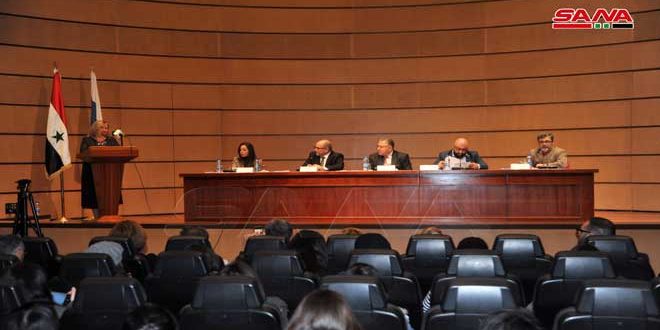
With the participation of representatives of higher education in Syria and Russia, Damascus University, in cooperation with Moscow State Educational University, held on Saturday a Russian language forum under the title “Promoting the study of the Russian language in educational institutions in the Syrian Arab Republic.”
The forum aims to exchange experiences and improve the dissemination of teaching Russian language and culture, and to discuss issues related to the teaching of this language and literature between Russian and Syrian educational institutions. This in turn would enhance scientific, cultural and social relations between the two friendly people.
In his speech, Rector of Damascus University, Dr. Muhammad Yasar Abdeen, expressed his hope that the forum would contribute, through its dialogue sessions, to raising the level of Russian language teaching, providing the necessary human and technical support in this field, and discussing mechanisms and methods for developing Russian language teaching and education. This would contribute to the graduation of qualified cadres in the Russian language and literature and support the Ministry of Education in teaching the Russian language in Syrian schools, knowing that the university is ready to provide all possibilities for the success of Russian language education programs in Syria.
Abdeen said that Damascus University has allocated a department of Russian language and literature since 2014. He underlined the importance of the department in getting acquainted with the Russian language, literature and Russian culture, considering it as a rich opportunity to learn about Russia’s history, science and culture, given that the Russian language is one of the most important living languages in the world.
Elena Ginadevna, Head of the Department of Russian Classic Literature and Director of the Institute of Philology at Moscow State Education University, pointed to the distinguished Syrian-Russian cooperation in all fields, especially in the scientific field.
She added that strengthening Syrian-Russian relations requires teaching the Russian language and exerting joint efforts to spread it in Syria, stressing the university’s readiness to assist the Syrian educational authorities to achieve this goal through specific educational programs and systems that encourage students to learn it.
Nikolai Sukhoi, Director of the Russian Cultural Center in Damascus, called for coordinating efforts with regard to teaching the Russian language at various levels through annual and monthly programs and literary, cultural and educational activities. He also called for conducting a number of these activities on the campus of Damascus University for all students interested in the university, not just students of the Russian language department.
Alexei Alexandrovich, head of the Christian World Union Association, said: We came with a delegation from Moscow Education University and we are preparing to open several departments of the Russian language in Syrian schools and universities, noting the existing cooperation with Damascus University in this regard.
In turn, Konstantin Ilyich, Director of the Center for Combating Terrorism and Extremism at Moscow State Education University, gave a presentation on the center, its objectives and experience in the field of combating terrorism and extremism. He noted that the students are the most active group in society and are the most targeted by the destructive forces which work to implant extremist ideologies among students.
Dr. Samih Zaza, Head of the Russian Language Department at Damascus University, gave a presentation on the nature of the study in the department and its scientific activities since its establishment, pointing to the increase in the number of students in it year after year.
Engineer Hala Dakkak, head of the Excellence and Creativity Authority, gave a presentation about the Authority and the National Center for the Distinguished. She said that the most powerful weapon against extremism and terrorism is science. So, the National Center for Excellence and academic programs at the university level are the appropriate place to start implementing activities to spread the Russian language through virtual classes and camps.
In his intervention, the Minister of Education, Dr. Darem Tabbaa, underlined the need for Russian language teachers. He said: We have 30,000 students who learn the Russian language in schools, and the number of teachers is fixed and limited. He underlined the urgency of establishing a center for preparing teachers for a period of two years to teach the Russian language. He pointed out that the Russian language curricula in schools were prepared with national expertise, and today the Moscow University delegation expresses its readiness to develop it according to international standards so that it can be easily comprehended by students.
On the 28th of last October, Damascus University signed a scientific cooperation agreement with Moscow State Education University with the aim of strengthening and developing scientific, academic and research cooperation, encouraging student and academic exchange between the two sides, and implementing and developing joint educational programs in the “Master’s and Doctoral” stages.
Inas Abdulkareem