
Russia to maintain its support for Syria until complete elimination of terrorism, attainment of political settlement
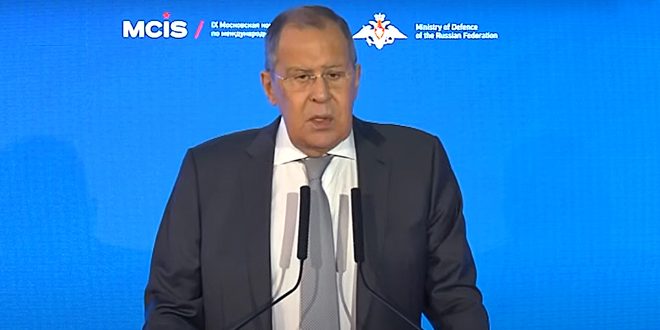
The Russian Foreign Minister Sergey Lavrov told the Moscow Conference on International Security on Thursday that his country has provided support for Syria’s war on terrorism and it will maintain this support until terrorism is completely eliminated and a political settlement is reached in the country.
Lavrov stated that the United States and some European countries are working to undermine the UN Charter and the principles of collective security and to set rules and form alliances that serve their agendas, which leads to the emergence of new “separation lines” in international affairs.
“We see how alliances are being imposed in Europe (the Pacific and Indian Ocean region) in an attempt to deter China and isolate Russia.
He stressed that there are problems in strategic security, particularly with regard to nuclear weapons, reiterating that Russia seeks to protect its security and the security of its allies, but the withdrawal of the United States from the Intermediate-range and Short-range Missiles Treaty and the Open Skies Agreement undermined the balance of power and interests, which prompted Moscow to withdraw from it.
Lavrov clarified that the European Union and the North Atlantic Treaty Organization (NATO) are calling on Moscow to preserve all these agreements despite Washington’s exit, pointing that Russia has a firm position and that the approach taken by European countries undermines strategic security.
The Russian top diplomat voiced his country’s readiness to engage in “honest and professional” dialogue in order to discuss specific initiatives on reducing military tensions between Russia, the European Union and NATO.
Lavrov reiterated that the Russian-American relations should include setting rules based on strengthening strategic stability, including limiting nuclear and offensive weapons.
“As far as the issue of the weapons of mass destruction is concerned, there is a priority for the Organization for the Prohibition of Chemical Weapons, whose work is unfortunately being undermined by the West,” Lavrov said.
“This has been clear in the West’s dealing with the chemical weapon file in Syria. There is a dire need to enhance the Biological Weapons Convention, but the West refrains from discussing it and establishes biological laboratories instead,” Lavrov made it clear.
On his part, Russian Security Council Secretary Nikolai Patrushev said “Fighting side by side, our troops and Syrian troops dealt a powerful blow to the terrorists, who were planning to create a global caliphate in Eurasia. During those difficult months, Russians, together with the brotherly nation of Syria, did not just fight for the future of Syria, but for the whole world that terrorists were acting against.”
Patrushev added “it is regrettable that certain states claiming to have the status of major powers did not consider it necessary to stand together with us against this evil, and they even made a great deal of effort to hinder the fight against it.”
According to Patrushev, Russia is actively aiding the post-war recovery of Syria, the return of refugees and their integration to peaceful life, providing humanitarian aid and helping to rebuild the economy, education and healthcare in the country.
Hamda Mustafa