
Restoration of ancient manuscripts to preserve Syrian cultural heritage
Syria’s rich cultural heritage is an expression of its cultural and religious diversity. The threatening loss of this heritage would also mean the loss of cultural roots.
Syrians at home and abroad are leading efforts to safeguard Syria’s cultural heritage and ensure that traditions are preserved.They are capable of playing an important and influential role in this sector, but they need to be given opportunities to unleash their potential.
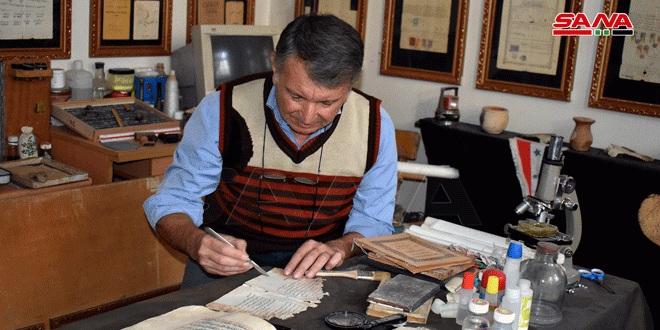
With precision and patience, Dr. Muhammad Khawatami restores old manuscripts and books in his small workshop, which he established in Bab al-Nasr neighborhood in Old Aleppo, with the aim of preserving the Syrian cultural heritage.
Dr. Khawatami, who grew up in this neighborhood which is famous for its libraries, told SANA “I was keen to learn the profession of manuscript restoration with the aim of preserving culture and heritage, so I started 50 years ago from just a hobby to turn into a profitable profession”.
Khawamati explained that the manuscripts, which he restores manually from old books and rare copies of Qur’ans, have been subjected to damage, erosion and tear within the written text including bonds and official papers of government documents, real estate and endowment restrictions, and genealogy papers belonging to families and clans in Aleppo.
He pointed out that these documents need a technical restoration process using natural restorative materials such as starch and cellulose leaves away from chemicals because of their harmful effect on paper.
Khawatami reviewed the stages of the restoration of manuscripts including documenting the manuscript and writing a report on it with its dimensions, number of pages, type of paper, existing font, type of ink and approximate age.
He added “ the restoration of each part of the manuscript is done separately, the dust and dirt removed from it carefully using a surgical scalpel, cleaning it with a special brush and sealing the worn-out pages until it returns to its natural shape”.
He stressed “the papers are re-woven and the pages are arranged as they were, with the commitment not to change the nature of the manuscript. It is placed in a folder with the report that documented it and is kept in the Manuscripts Museum”.
Dr. Khawamati indicated that the techniques of restoring ancient manuscripts are carried out in a sophisticated and modern way, using cellulose paper to cover the holes and wear because it covers the opening without obscuring reading the words of the manuscript text.
Dr. Khawamati, who stressed the importance of restoring manuscripts because they are a reference for generations, reviewed how he preserves his private possessions by placing them within wooden frames with crystal panels that preserve them from environmental factors so that their color does not change or their ink dries out in order to preserve their historical value.
He called on the concerned authorities and all those interested in the restoration of manuscripts to preserve the existing manuscripts at official departments or at homes as they are national historical documents.
It is noteworthy that Dr. Muhammad Khawatami participated in document preservation techniques workshops with the United Nations Educational, Scientific and Cultural Organization (UNESCO) and the Mtinadaran Institute and Museum in Yerevan, Armenia. He also held several exhibitions and workshops in cooperation with the Directorate of Culture in Aleppo on the restoration mechanism.
RawaaGhanam