
Rania Maasrani, a Syrian artist who excelled in sculpting, Ajami art and photography on strings of music
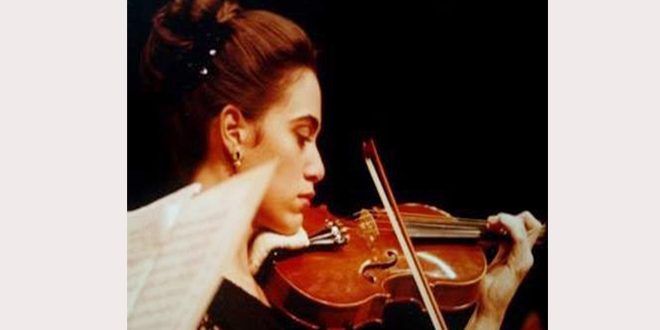
With the same hand that played music to create the most beautiful international melodies, the musician Rania Maasrani carved on the rock scenes from the ancient Syrian civilization to establish them as a strong unique document depicting the strength of the Syrian female spirit.
Academic musician Rania Maasrani, in her unique experience, combined music, plastic art, Ajami art and photography to create a special impression of beauty.
Rania’s story with music began at the age of six at the Arab Institute of Music (currently Sulhi Al-Wadi Institute) and at that time she drew paintings with pencils and ink.
With time, she developed her drawing and began painting with Chinese ink in black and white, and at a later period she introduced watercolors to Chinese ink.
In the field of music, she graduated from the Higher Institute of Music, specializing in the violin. She was a founding member of the Syrian National Symphony Orchestra led by Maestro Sulhi Al-Wadi in 1993. She played with the Symphony Orchestra led by Maestro Misak Baghboudrian in many Arab and foreign countries and a number of Syrian cities.
Rania is a participant in the Syrian National Band for Arab Music, led by Maestro Adnan Fathallah, and in the Orpheus Orchestra, led by Maestro Andre Maalouli. She won the silver medal in 2011 from the French Academy of Arts, Sciences and Letters, which was founded in 1915.
In Rania’s plastic work, we find diversity between different types of arts, from Chinese ink and watercolor to sculpturing.
In this way, the antiquities of Palmyra were documented by presenting ancient floral, animal and engineering carvings and drawings derived from the local environment.
She reflected her influence on what Palmyra was subjected to at the hands of the terrorist organization “ISIS”. So she searched and read about the great Palmyra civilization and the carvings in its temples, and was fascinated by women’s ornaments of beauty and good taste. So she studied them carefully and then held an exhibition at the Opera House in 2019 and almost half of the exhibits were sculptures inspired by Palmyra.
Rania’s creativity did not stop here. She was fascinated by the prominent colorful wooden ceilings and painted cupboards in the old Arab Damascene houses “called as Ajami”. She learned the Ajami technique and then started using this technique in her drawings.
Sculpture with Rania has a different story, as she entered the field of sculpture after visiting Ahmed Walid Ezzat Center in Damascus, from which she learned the colors of ceramics, and then discovered there the pleasure of sculpting. She also practiced photography.
Rania has held a number of solo exhibitions, including at Al-Riwaq Gallery in Jordan, the National Museum of Damascus, the Syrian Cultural Center in Paris, Ishtar Hall and the Opera House in Damascus. She has group exhibitions at the Russian Cultural Center in Damascus and the Arab Cultural Center in Abu Rummaneh.
Inas Abdulkareem